Fine Tuning for Auto Service Success
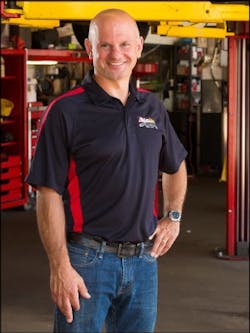
For more than five years, John Manelas looked for a way out of the corporate engineering world. His desire to interact with his community led him to opening his own business with his wife, Karen. Considering everything from restaurants to a flower shop, his experience in the auto industry ultimately directed them to purchase an auto service center.
In 2004, Manelas bought a fading, four-bay shop that would stretch his understanding of what it meant to run a business. Encouraged to pursue industry training, Manelas joined a 20 Group in 2005, where he learned to focus on key performance indicators (KPIs) and standardized operating procedures while ultimately building his “tin can” four-bay shop into a $1.45 million sales machine.
As an electrical engineer in automotive factory automation for 16 years, Manelas always had a fascination with numbers. Now, every number he can track for his shop, he does. Additionally, he’s found an opportunity to grow a local business and give back to his community.
Locations: 2 in New Hampshire (cities of Merrimack and Manchester), and one in South Portland, Maine
Owner: John Manelas
Size: 2,400–4,000 square feet
Staff: 19 (total)
Annual Revenue: $3.15 million (total)
Average monthly car count: 785
When Manelas took over, his shop had just two employees, while he worked the front counter. He began learning the idiosyncrasies of owning a shop, but brought in just $550,000 in sales the first year. Now, Auto Care Plus includes two additional shops that are beginning to take on the same efficient profile as his original, reinvigorated Merrimack, N.H., shop.
In 2013, the business generated more than $3 million in total sales.
Manelas continues to find ways to improve sales, out-do benchmarks and track more KPIs. As he began, the struggles of losing previously loyal customers and market share turned to making a gross profit, increasing his customer pool and gaining a new outlook on sales.
“Getting the courage to hire another person and do the marketing you need to actually get the business going was the struggle,” Manelas says. “I learned quickly you have to make a gross profit, being the owner at the counter you tend to discount too much and not charge enough. The advice was clear the whole time, you’ve got to be sure to hit the benchmarks.”
Maximizing The Bottom Line
Manelas’ training and attention to detail led him to make crucial changes. He began by rethinking the way he viewed his sales as a whole and then worked to increase his customer base through marketing.
His next step was to boost labor efficiency through standardized processes and incentivized pay. Finally, he’s begun to make the finer adjustments in efficiency through company-wide performance comparisons.
Rethinking the Product: Manelas began by working through his sales numbers, tightening the labor margins that had previously slipped into unprofitable territory and rethinking his labor strategy at all of his facilities.
Manelas has grown his labor margin from 60 percent to 72 percent.
“Labor is your most important asset, the most important piece of inventory that you sell,” Manelas says. “Without tracking it to the minute, you have no idea how much money you’re letting walk out the door. It’s not like you can sell it tomorrow or the next day. You’ve pretty much lost that inventory.”
Manelas began tracking his technicians’ time with Tech Time Clock, an electronic time clock that integrates with his management software to help his tech know what work has been approved and the vehicle’s history. His estimates now show that his shop loses more than $3 per uncharted minute.
“You’ve got to have your technicians keeping time on everything they do,” Manelas says. “You’ve got to show them their efficiencies and productivity to keep everyone striving to get better; that’s where a lot of our money was recovered and made.”
Viewing labor as a good to be sold, Manelas pays his technicians on a flat rate scale, allowing technicians to increase their rate when hitting tiers of hours billed. That shifted the pressure onto Manelas to bring in the work, keeping his techs busy and their families fed. From there, he found the importance of maximizing the sales peaks, and minimizing the valleys through quality marketing.
Allow Marketing to Work: Manelas treats his marketing budget like another employee, earmarking the money for 6–9 percent of anticipated sales.
“Some people say ‘I can’t believe you spend that much money on marketing,’” Manelas says. “Well, in January or February, when everybody else is dead, we still have work.”
Watching other shops go through new marketing strategies month after month, Manelas gives his strategies time to work or fail.
“A lot of guys just throw darts at the dartboard and say ‘Oh, I’ll try this and try that.’ Stick with it for a year and measure it, and see how it did,” Manelas says.
Auto Care Plus’s roughly $90,000 marketing budget per shop for 2014 won’t escape his infamous pie charts, as everything in his shop is tracked. Future strategies are then based on the incoming information.
Manelas implements everything from direct mailers, snowstorm specials and car care clubs to oil change packages and witty messages on his LED sign.
His front counter team tracks each campaign through a spreadsheet in the shop’s management system, charting which tactic brought in which customers and how much those customers spent. By doing this, he can get a fairly clear ROI on each item.
For instance, a AAA discount campaign yields ticket prices twice that of his business’s average.
“Things like the five-pack oil change allows us to build a rapport with our customers,” Ryan says. “We know we’re going to see them at least five times.”
Boosting Labor Efficiency: Manelas pays his techs on a tiered flat rate, with a scaled wage increase based on hours billed. He says it can be hard to find motivated techs that can keep pace with the efficiency of his shops, but that when he does, it pays off for everybody.
“Usually the guys who come to you with performance numbers and they already know their efficiencies, are going to be a good hire,” Manelas says. “It’s hard finding people that want to work that way, but when you do, you take it seriously.”
Manelas learned that in order to attract technicians that fit and thrive in his shops, he had to provide a quality work environment, with benefits and a place where everyone could excel.
He’s also implemented an incentive-bonus program, awarded monthly or quarterly. It’s not limited to front-counter staff, either. He’s done $25 bonuses for every Google review staff members bring in.
“Whatever they’re deficient in and I want them to improve in, I usually tie money to it,” he says.
The result, says the shop’s operations manager Danny Ryan, is a staff full of employees pushing their own efficiency.
Fine Tuning: Manelas posts the performance numbers he tracks companywide. He says it breeds friendly competition, but also holds employees accountable for their work. Alongside the numbers, though, Manelas stresses the importance of giving personal feedback on a regular basis, including a report card with each paycheck at the end of the week.
Those report cards track the store’s performance and the employee’s individual numbers. Then he posts a company-wide, three-store report card at each shop.
The shop reports will include numbers like gross sales, gross profit, average RO, car count, and new customer count.
The individual report cards focus on benchmarks for a given position. For techs, that means an average RO of $350–$380, an effective labor rate of 100 percent, efficiency of 138 percent and productivity of 90 percent.
“Everybody has access to the numbers and they see that all the boats rise with the tide,” Ryan says.
Manelas expects the benchmarks to be maintained once they are achieved, allowing him to change the target numbers quarterly or yearly once the benchmark is met.
Investing In The Future
With the growth he’s seen, Manelas has found other ways to build his company. His original three-person crew has grown into a three-shop operation, and Manelas has seen that his original shop is reaching its peak performance.
Manelas says his 20 Group through RLO Training has been pushing him to expand the maxed-out shop that hits at 135 percent factory utilization.
“You can see certain benchmarks as to when you need to add a tech or service adviser. They say we’re trying to squeeze too much out of it and the wheels are going to fall off,” Manelas says. “We’ve drawn up some plans and we’re looking at expanding—so it’s going to be growing pains all over again.”
Manelas has also focused his attention on building and maximizing the output of his other two locations. One way he does that is by paying for his techs to receive continued training, including ASE certifications, to keep his techs well educated and his shops competitive in the market.
He’s also worked to keep the lines of communication open between all three of his shops, allowing them to share the knowledge and techniques that have already turned around his original location.
Giving Back
A large part of his success, as well as the reason he got into the business, is working with the community.
Manelas’ shops work with organizations like Good News Garage, facilitating car donations and helping with the repairs of those cars. They also work with a local nonprofit, Marguerite’s Place, that provides housing and support for homeless women and children. Manelas’ team helps with general facility repairs and affordable auto service.
Not only does Auto Care Plus gain exposure in the community, but the efforts boost morale throughout the entire team at each shop.
“When you help somebody out, it feels good to everybody,” Ryan says. “It builds up the whole mood and atmosphere.”