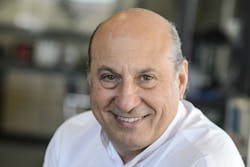
If you flip through the various television channels in Dallas, you might come across a strange commercial: A man in a bathrobe reading a bedtime story ... to a car.
“So the mama Porsche said to the baby Porsche, ‘Who’s been parking in my spot?’” says Nerces Mavelian, as he closes the book and pats the car good night.
It’s odd, surreal, completely bonkers—and, believe it or not, it’s an effective marketing strategy. That commercial, entitled “Cars Are Like Kids,” earned Mavelian, owner of three Autoscope Foreign Car Care locations in Dallas, a bronze trophy at the 2015 Telly Awards, which honors the top commercials in the country.
But Mavelian didn’t film the commercial for awards—he made it for his customers.
“People who recognize me will stop me all the time on the street,” he says. “Some love the commercials, and some people joke about how much they hate them. But it’s always in good fun. They feel like they know me.”
Mavelian’s branding strategy is indicative of his customer-centric philosophy at Autoscope, which specializes in foreign models, services an average of 685 cars monthly, earns $6 million per year, and continues to expand its reach in the Dallas area.
A NARROWED SCOPE
AUTOSCOPE FOREIGN CAR CARE - PARK CITIES
LOCATION: Dallas
SIZE: 20,000 square feet
STAFF: 12
NUMBER OF LIFTS: 22
AVERAGE MONTHLY CAR COUNT: 300
ANNUAL REVENUE: $2.8 million
In 1969, Mavelian’s father, Ohannes, moved the only VW-factory authorized independent shop in Lebanon from Beirut to New Jersey.
Then just 13 years old, Mavelian loved taking toys apart and putting them back together, but never held a passion for auto repair. Instead, he studied electronics at William Paterson University and moved to Dallas to work on IBM’s latest computer technology in the late 1970s.
“The [auto repair] business was too dirty for me,” Mavelian says. “I was a clean guy. I wanted to distance myself from the mechanical work.”
Years later, Mavelian realized his expertise lent a unique business opportunity to his father’s shop: While most domestic cars before 1986 were equipped with carburetors, early foreign models contained fuel injection systems. And with the European car market increasing, there was a demand for specialized repairs.
“It was very difficult for the layman to know how it works. Even some of the mechanical experts didn’t deal with fuel injection,” Mavelian says. “They really would not understand the idiosyncrasies. It was dealer-only type of repair. So it was a perfect time for me.”
At IBM, Mavelian would use his oscilloscope to take motherboards apart, isolate the faulty part, replace it, and put the board back together. Realizing he could train technicians to diagnose cars the exact same way, he moved his father to Dallas and opened the first Autoscope location.
ATTRACTING THE RIGHT CUSTOMERS
AUTOSCOPE FOREIGN CAR CARE - PLANO
LOCATION: Dallas
SIZE: 10,000 square feet
STAFF: 8
NUMBER OF LIFTS: 9
AVERAGE MONTHLY CAR COUNT: 250
ANNUAL REVENUE: $2 million
Mavelian says his branding efforts boil down to one philosophy: Make it more personal.
When Autoscope opened in 1982, there were few Dallas businesses offering service on foreign cars, and Mavelian took advantage of an isolated database of high-end customers. He targeted them through print and radio advertising, branding his shop’s unique expertise as an alternative to expensive dealership prices.
“If your car is under warranty with a dealership and I inspect your car, I still like to give you a heads up on the problems you’ve got,” he says. “Because now you’ve got a clean car when it comes out of warranty and you know you can trust me.”
He would boast about his technicians’ expertise in fuel injection technology, and sell regular, scheduled maintenance as the key to keeping your car running smoothly.
“Our customers’ vehicles are more expensive. If they haven’t been keeping up with regular maintenance, they’re going to have $5,000 in repairs once they get out of a warranty,” he says. “We offer to prevent the huge repairs with regular upkeep.”
Today, Mavelian uses the same scheduling tactics he did in the 1980s. He reserves at least 15 minutes for each appointment, allowing the service advisor enough time to sell repairs and schedule future maintenance.
It’s simple and straightforward, but it’s a feature Mavelian loves to play up: You can’t get this kind of attention at the dealership.“I’m trying to make an impression, make it more personal,” he says. “If you say ‘Autoscope,’ people in the industry know our branding and our philosophy. I want customers to know our name as well.”
REVAMPING MARKETING EFFORTS
Mavelian’s marketing efforts have evolved as his shop network has grown, adding his second facility in 1993 and his third, most successful location in 2008.
“We had little competition in the beginning, but now each location has 10-plus competitors,” he says. “Competition is good. It makes us sharpen our efforts and stay fresh so we don’t get passed up.”
Improving his shops’ search engine optimization (SEO) has been essential in landing foreign car owners. Through trial and error, he shied away from pay-per-click campaigns that were barely increasing his search engine rankings and instead focused on driving organic Google search results through blog entries that utilize often-searched keywords specific to foreign car repairs.
“I would speak with and survey my clients, and they’re just not the kind of people to click on payper- click ads,” he says. “These days, they’re so aware of the ad on the side, the pop-ups, and they'd rather not click on the ad. I wouldn’t want an ad either. I want what real people are saying.”
One of the biggest SEO enhancements has been online reviews. Mavelian pushes his staff to collect written testimonials for the website—currently, the three shops are displaying more than 400 reviews with an average rating of five stars.
NO SUCH THING AS BAD PUBLICITY
AUTOSCOPE FOREIGN CAR CARE - WHITE ROCK
LOCATION: Dallas
SIZE: 7,500 square feet
STAFF: 7
NUMBER OF LIFTS: 7
AVERAGE MONTHLY CAR COUNT: 135
ANNUAL REVENUE: $1.2 million
The real turning point of Autoscope’s branding strategy came with the award-winning commercials, which Mavelian started airing two years ago.
He hypothesized commercials would set his shops apart, since radio and print advertising was the norm and very few of his competitors use television for marketing. He decided to make a small investment in some commercials and track the outcome for several months.
Mavelian says the top-of-mind awareness they created became invaluable. After the first commercial, people started recognizing him in public, and foot traffic immediately increased. He soon increased the commercial budget by 30 percent, and now spends $8,000 on production and $8,000 for air time each month.
“If you don’t have an issue with your car, you don’t need my services at that minute,” he says. “However, with a consistent reminder of our services offered for their vehicles during their TV programs, they are more likely to pick Autoscope over the other firms because of a familiarity association.”
He hired an in-house team—including his friend Jeff Gibson, an Emmy-winning director with Fox—to shoot a new commercial each week. The commercials are then posted on the company’s YouTube channel and promoted through Facebook and Twitter to extend their reach.
“[Gibson] was looking for something different, so we decided to work together, making funny and memorable videos for the web as well as TV,” Mavelian says. “Jeff brought the rest of his gang with him.”
Whether Mavelian’s commercials are silly or serious, he’s conscious of his audience. He only advertises on cable, and caters the tone and nature of his advertisements to specific demographics on certain channels. He has a straightforward commercial discussing the shop’s specialties on the business channels; a commercial targeting women on HGTV and Bravo; and goofy commercials (like the Telly Award winner) looping on basic channels that air sitcoms.
“I don’t worry about being too goofy,” he says. “Really, people will remember you whether they like the commercial or not. It doesn’t matter when it comes to needing repairs. There’s no such thing as bad publicity.”
A Customer-Centric Facility
Mavelian’s customer-first mentality culminated with the latest Autoscope facility: 20,000 square feet that staffs 12, repairs 300 cars per month, and pulls in $2.8 million per year.
He says the atmosphere of his third location— which Mavelian designed over several months with three architects—caters to the customer in every way: the gentle, earth-brown paint schemes; the spacious, modern lobby; and the floor-to-ceiling glass wall that looks out onto the 22-bay floor.
“You can literally see the transparency of what we do, see what we’re working on,” he says. “I want to raise that trust level. Whether or not you’re mechanically inclined, it’s nice to see someone treating your car the way you want it to be treated.”
Each service writer has a cubicle for oneon- one time with the customer and is positioned near a window to see customers walking in. The lobby television airs stories about Autoscope customers and their cars, and the company website displays dozens of photos of customers receiving their completed vehicles. And, whenever requested, Mavelian welcomes a customer to tour the shop floor.
“If you can walk into a shop and not get your feet dirty and not have to watch for oil spills? That makes a big impression,” he says. “They’ll think, ‘These guys do wonderful work. If they’re going to take care of their shop this way, they’re going to take great care of my car as well.’”
About the Author
 Travis Bean