Employee Ownership: Brad’s Service Center’s Story of Succession
Key Highlights
- Succession planning is often complex, especially when there is little prior discussion or formal strategy in place.
- Leveillee’s transition involved overcoming immediate operational crises and rethinking long-term ownership through innovative models like Teamshares.
- Employee ownership can be a powerful solution, but it requires transparent communication and involvement of the entire team to succeed.
- The process of transitioning to employee ownership involves emotional considerations, trust-building, and strategic leadership changes.
- Partnering with organizations like Teamshares offers a practical alternative to traditional ESOPs, especially for small businesses seeking to reward loyal employees.
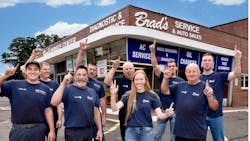
Succession is a topic most shop owners will face at some point, and it can be one of the most difficult. Deciding who will take over the business is never an easy choice. In some cases, shop owners aren’t leaving the business to one person; instead, they are transitioning to a model of employee ownership.
When Peyton Leveillee was left with his father’s shop after this death, he was met with the same predicament. Though he wanted to convert the shop to employee ownership, the path to get there wasn’t so clear because there had been little planning and zero discussion about it beforehand.
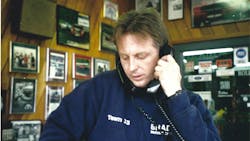
Returning to the Family Business
Leveillee’s father, Brad Leveillee, first opened the shop around 1980, just after graduating from high school. It was originally a gas station and a two-bay shop, with Leveillee’s father being the only employee. Through a connection with the original owner, he took it over and implemented increasing expansions from the 1980s into the early 2000s.
The shop went through several different locations before ending up at its current spot in Chicopee, Massachusetts, growing from a one-person operation to a main garage with nearly 25 bays and a staff that included 7-12 technicians and three office personnel.
“He really put everything into the business that he had. Growing up, I remember him going to work at four in the morning and coming back home at eight or nine at night,” recalls Leveillee. “He really gave it his all.”
Leveillee assisted with small odd jobs as a kid, but as he came of age in the 2010s, he became more involved and realized he had a passion for the backend work of the business—specifically marketing. He decided to attend college and study business and psychology and began working within marketing and tech sectors.
During the COVID-19 pandemic, Leveillee returned to support the family business after the death of his father. With no succession plan and a team of loyal employees—some having worked there longer than Leveillee had been alive—Leveillee wasted no time in picking up the reins.
In the first week of taking over, the roof collapsed, the water heater stopped working, and the phones were dropping calls due to old wiring in the building. While Leveillee’s father handled much of the building maintenance, his declining health left much of it unattended.
While Leveillee had never planned to run the business himself, all he could focus on at first was keeping it afloat in his father’s absence. Fortunately, with a stellar customer service team, much of the focus was updating equipment for the shop, like lifts and oil systems.
“There were just so many fires that immediately needed to be dealt with. So, you know, my first year in the business was just heavily reinvesting back into the infrastructure that was there,” Leveillee explains.
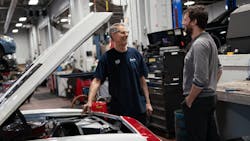
A Solution That Checks all the Boxes
After about a year of helping the shop get back on its feet, Leveillee began considering the next steps. He didn’t intend on running the shop long-term; he planned to move to California and pursue a different career path. He thought back to a concept he learned during his time in college: an Employee Stock Ownership Plan. Having heard it pitched as a solution in scenarios with family businesses facing succession issues, Leveillee wondered if an ESOP could be the solution his family’s business needed.
“I was like, ‘Okay, could something like this be a succession plan for me?’ Could I use an ESOP to exit the business but put the equity where I think it needed to go—which is with the people that really built this business,” Leveillee recalls.
It was the right track but needed more work. Upon further research, Leveillee determined an ESOP would be too complex and expensive for a small shop but he still wanted to leave the business with the people connected to it.
With his father passing away without a will, Leveillee was prompted to make up his own will. In speaking with his lawyer about the situation with the shop, he learned of Teamshares. Leveillee’s lawyer had recently represented a business that sold to the company with the goal of transitioning to employee ownership. It immediately caught Leveillee’s interest.
Employee ownership with Teamshares works a bit differently from something like an ESOP. Teamshares starts by purchasing the business from the owner, and upon sale, grants 10% of the company’s equity to the employees. Then, over time, the company uses its own profits to buy out Teamshares’ remaining ownership, gradually increasing employee ownership. Employees do not need to put in their own money and receive dividends based on the company’s profits as the process continues.
Upon reaching out to Teamshares, Leveillee not only met with representatives of the company but also former owners of businesses that were taken over by Teamshares. Leveillee got to hear firsthand accounts from people who went through the process and what it entailed for them. He soon decided that his goal for the shop was something Teamshares could help him achieve.
“It checked the number of boxes that I thought were really important: I was able to move on. The business was able to keep its name. People were going to get rewarded for their time spent in the business without having to pay a bunch of money into something,” explains Leveillee.
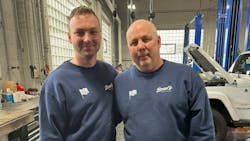
Involve Your Team in Every Step
While inviting Teamshares to take over did end up being the right choice for him, Leveillee was met with uncertainty from shop employees. He first shared the news with just the shop’s general manager and lead diagnostician, who initially agreed with the idea—but the day after breaking the news, they began to have doubts and considered leaving.
It was a terrifying moment for Leveillee, who had been working hard to keep the shop together. It required an extra push to involve the employees in a process they had, until then, been largely unaware of. Teamshares’ leadership—including the COO, CEO, and others—flew out to the shop for an after-hours group conversation to address the general manager’s and lead diagnostician’s concerns.
“I think what we ultimately came to was, ‘Look, they just needed some more time to sit with this.’ Because if you tell someone, ‘The business is going to become employee owned; it’s ultimately changing hands; we want you to be bought in,’ that’s not something people get to within a day,” says Leveillee. “So, take some time. Ask us some more questions. Let’s figure out how we can make this work. There was a lot of space for communication.”
That communication was essential. It helped Leveillee’s two lead staff members understand that it was a plan for them to acquire ownership of the business without taking on any debt. After about a week and a half of discussions, they broke the news to the rest of the team, who—with the support of Leveillee’s lead members—were on board.
With the transition in motion, the shop appointed a new president to help fill a leadership gap. While the existing team was strong in technical and operational roles, Leveillee realized there needed to be a figure that would guide the team through managing aspects like systems, equipment, and coordination.
Leveillee had so much success with Teamshares that he now has a career with the company as an industry lead. But it was a long, hard road to get to where he is now. A shop looking to transition to employee ownership can’t take any shortcuts there—it can only happen with dedicated, consistent communication with your whole team.
“I do think one of the hardest things is the transition away from the former owner. The emotional ties that person has to the business—the emotional ties that all the employees may have to them,” says Leveillee. “I know that I’m coming from a lens of, ‘This is my father.’ Other former owners might have different relationships with their employees, and that’s fine. But ultimately, it’s a change, and getting anybody to buy into a new leader takes time. Both parties need to show up. Both parties need to trust each other.”
About the Author
 Kacey Frederick
Kacey Frederick
Associate Editor
Kacey Frederick joined as the assistant editor of Ratchet+Wrench in 2023 after graduating from the University of Arkansas at Fort Smith with a bachelor’s in English and a minor in philosophy.
The grandchild of a former motorcycle repair shop owner, he’s undergone many trials and tribulations with vehicles. Now the proud owner of a reliable 2011 Toyota Camry, he works to represent those in the repair industry that keep him and so many others safely rolling on.