The PART Act: How it Could Help Auto Shops Address Catalytic Converter Theft
Key Highlights
- The PART Act seeks to establish VIN-linked identification and standardized record-keeping for catalytic converters to combat theft.
- Auto repair shops will play a crucial role in marking existing converters and educating customers about theft prevention options.
- A $7 million grant will fund converter marking services, involving repair shops, law enforcement, and auto dealers in theft prevention efforts.
- Legislation has broad bipartisan support, recognizing the widespread impact of catalytic converter theft on vehicle owners and businesses.
- Independent shops are encouraged to share their experiences with theft to help shape effective policies and advocate for their interests.
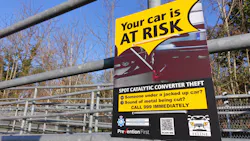
In recent years, catalytic converter theft has dominated news across the U.S., plaguing not only drivers, but those who purchase and sell the component, and the businesses servicing these cars. A piece of legislation currently in Congress, the PART Act (H.R.5221), may enable nationwide standards for converter etching, creating a program that would involve different parts of the automotive industry, including independent repair shops.
Emil Nusbaum, vice president of government and regulatory affairs for the Automotive Recyclers Association, shared with Ratchet+Wrench how this bill could benefit auto repair shop owners, and what role their businesses would play in its implementation if passed.
Finding an Industry-Wide Solution
Catalytic converter theft became an especially prevalent issue after the pandemic in 2020, with supply chain constraints driving up the cost of the precious metals that make up catalytic converters: platinum, rhodium, and palladium. The component became an accessible type of crime for both lone thieves and organized rings, with stolen converters laundered back into the legitimate recycling market for high profit.
Stolen converters were being sold for as little as 50% of market price, leading to a suppressed market for legitimately sourced converters.
“We saw this became a nationwide issue in every state; we actually had several examples where legislators themselves ended up being victims of catalytic converter theft,” says Nusbaum. “It’s been impacting all vehicle owners, really, throughout the country.”

This prompted feedback on a legislative level. Since 2021, over 200 pieces of legislation trying to address catalytic converter theft have materialized, and over 34 states have passed legislation to strengthen existing laws. Much of this legislation targeted loopholes utilized by thieves.
“When we did a 50-state survey of what existing laws looked like, what we found was, in many cases, there were these broad, business-to-business exemptions,” explains Nusbaum. “Essentially, if you had a business operation or a licensed business, you may actually be exempted for any record keeping at all, if selling it to a scrap processor. And that was legal.”
Businesses selling catalytic converters—no matter how large or frequent the quantity—have largely not had to identify themselves to scrap processors or recyclers. Where they received the components and what vehicles they came from is vital information that is typically left unrecorded as well, leaving the absence of any paper trail.
ARA is one of several members of a group that helped form a framework for what effective anti-theft laws would look like, which would become the foundation for the PART Act. Other members included vehicle OEMs; law enforcement on the state, federal, and local level; and auto theft investigators.
Through efforts like the 50-state survey, the group was able to identify loopholes in current statutes and where record keeping and traceability were failing.
A solution, the group determined, would need to focus on closing laundering pathways, requiring better documentation of converter transactions, and creating ways to link a converter back to a specific vehicle, i.e., a VIN.
With the PART Act, catalytic converters would be added to a list of major component parts that should have a VIN or VIN linked identifier on them and would require all catalytic converters produced to be stamped with the VIN of the vehicle they will occupy. This makes it easier for law enforcement to trace a stolen catalytic converter back to its owner.
Additionally, the PART Act would require standardized record keeping requirements for catalytic converter transactions and would add or increase criminal penalties specific to converter theft and related activity.
Currently, there are over 120 organizations supporting the PART Act, including groups representing law enforcement, insurance representatives, and automotive dealers. The bill is still working on building bipartisan support in Congress, which so far has not been a difficult challenge.
“It’s really a bipartisan issue, so there’s really not a lot of opposition to this bill,” Nusbaum says. “It’s something that’s really benefiting everyone, whether you’re a member of Congress, a vehicle owner, a repair shop, an auto recycler, or a fleet operator.”
“The First Touchpoint for Vehicles”: The Role Repair Shops Play
Thankfully, for independent shops, the PART Act shouldn’t impact the availability of catalytic converters in the supply chain—however, they will play an important role in ensuring their customers benefit from the bill.
While new converters will be etched, there’s still the issue of existing converters not having any identification. This is where independent shops will be especially important, and eligible for an opportunity to expand their business’ services.
Under the PART Act, a $7 million grant would be established to help expand catalytic converter marking services. It would be part of a nationwide effort to help curb catalytic converter theft as much as possible, involving not only independent shops but also law enforcement agencies, auto dealers, owners, and lessees of maintained fleets.
As Nusbaum points out, it will be crucial to involve auto service providers in the process of marking converters, as it’s often the most accessible place for drivers to learn about what options are available to them.
“As one of those first touchpoints for vehicles, as well as repairs, maintenance, and service, you would want to be certainly including the repair industry,” adds Nusbaum.
In addition, it’s not just vehicle owners that have suffered from catalytic converter theft; automotive repair businesses have been targeted as well, especially when there are vehicles left unattended after hours, as is the case at many shops. Proponents of the PART Act hope to deter theft altogether if catalytic converter marking becomes more common and making the component less appealing as an easy target for theft.
“In a lot of cases, we’ve had some members that had people break down gates and do a lot of property damage, just to steal this one type of component that they suspected was being stockpiled at one of these facilities,” Nusbaum says.
As the PART Act progresses through Congress, Nusbaum encourages those interested in the bill to reach out to their local member of Congress to share any experience they may have with catalytic converter theft. As with any legislation involving the automotive industry, it’s important for independent repair shops to use their voice and ensure they’re represented.
“If you’ve been directly impacted, those types of stories carry a lot of weight,” adds Nusbaum.
About the Author
 Kacey Frederick
Kacey Frederick
Associate Editor
Kacey Frederick joined as the assistant editor of Ratchet+Wrench in 2023 after graduating from the University of Arkansas at Fort Smith with a bachelor’s in English and a minor in philosophy.
The grandchild of a former motorcycle repair shop owner, he’s undergone many trials and tribulations with vehicles. Now the proud owner of a reliable 2011 Toyota Camry, he works to represent those in the repair industry that keep him and so many others safely rolling on.