Industry Evolution: Insights from Retired Shop Owners on the Past, Present, and Future of Auto Repair
Key Highlights
- Industry veterans recall the early days of auto repair, emphasizing the importance of passion, community involvement, and adaptability.
- Technological advancements have increased the complexity of repairs, requiring shops to narrow their focus and invest in specialized training and equipment.
- Workforce challenges, including talent shortages and behavioral issues, highlight the need for better training, mentorship, and empathetic leadership.
- Ownership transitions, especially to private equity, raise concerns about community ties and the long-term commitment of shop owners.
- Successful shops of the future will prioritize understanding their financials, nurturing employee relationships, and maintaining a clear business focus.
Any industry can look back fondly on its history and recall certain periods with a googly-eyed “those-were-the-days” nostalgia. Although Americans have had a love affair with the automobile since its debut in the early 1900s, the same cannot be said for the aftermarket and those who toil endlessly to keep those vehicles rolling down the road. While the American Automobile Association reports two out of three U.S. drivers do not trust auto repair shops in general, Consumer Reports paints a happier picture, with members favoring independent repair shops for service over dealerships.
For those who remember what it’s like to raise the hood of a vehicle or roll a creeper underneath it to dig into a problem, let’s take a walk down memory lane. For those who purchased a shop in the early 2000s and can still recall the adrenaline rush of pinpointing those early technology problems in first-generation navigation systems and sensors, let’s have a laugh over those hair-pulling moments. For everyone else, let’s have a look at the industry prior to you joining it. And let’s hear from those who came before you about what it was like, where’s it’s headed, and what you can do to prepare for the future.
A Look Back
When Joe Marconi left college in 1974 to pursue a career in the automotive industry, his father, Nick, didn’t bat an eye. As the co-owner of a full-service gas station which also meant taking care of car problems decades ago, Nick had no doubt his son would flourish on his career path.
“Imagine your child telling you that they’re going to leave business school to work at McDonald’s for minimum wage. And that’s (basically) what I did,” says Marconi, who owned three automotive repair shops until he sold them in 2021. “My father said, ‘follow your dream, follow your passion.’ He didn’t say anything negative. He just said whatever you want to do, just be the best at it. So, that’s what I did.”
Marconi began working as a mechanic—the term he used to describe himself before “technician” took over in the industry—for several shops until he opened Oceola Garage in New York in October 1980.
The mechanic-turned-owner admittedly had no idea what he was doing.
“I struggled for about 10 years because I was a technician turned shop owner and I had no business being in business, to be honest with you, because I was just a technician,” he recalls. “Being a qualified technician has nothing to do with running a business.”
He credits an industry trifecta as his reason for staying in business in those early years.
"There were three things back then that kept us in business—General Motors, Ford, and Chrysler,” he quips. “Because those cars broke down like you wouldn’t believe.”
In Gaithersburg, Maryland, Karim Morsli took a different path to owning Winkler Automotive. The engineer combined his love of cars with his technology-driven background to provide a “mixture of high tech with the human touch of delivering service” for 10 years as a shop owner before selling and turning his attention to mentoring others in the business.
“I learned a lot about the do’s and don’ts of running a shop and being a top shop, and I learned a lot from my peers in the industry because I knew very little,” Morsli explains. “Towards the end of my tenure, I decided to give back and help out some other up-and-coming shop owners because I was fortunate enough to have received so much from others.”

Changes in Culture
As technology flourished in the industry, Morsli says, the talent pool unfortunately did not. In fact, building a quality team became a tall order for him and many other small shop owners who were often required to wear many hats. Complicating matters, he says, are the types of training he felt he needed offer in an already strained labor pool and the whole process just became too much.
“Now it came down to having to teach them personal behavior or the right way to conduct yourself, things that are basic in society,” he explains. “And I found that in the end, after 10 years, I didn’t see that there was progress being made in the quality of some of the candidates that we were getting.”
For his part, Marconi describes a do-it-my-way-or-get-out mentality that raised his generation that no longer exists.
“My boss said to me, ‘You come to me after 30 days, and we’ll sit down and talk if you’re still here’,” he explains. “And he says, ‘And by the way, there are three ways of doing things, the wrong way, the right way, and there’s my way. You do things my way, and we’re going to get along just fine.’ That wouldn’t fly today.”
Both Morsli and Marconi agree that the culture of shops has changed, some for better and some for worse.
“I think the challenge for shops today is to find the right people to adopt the right philosophy in their shops,” Morsli notes.
Marconi adds the only way to do that is by getting personal.
“Shop owners of today have to understand that they need to have empathy for their employees. They need to respect their employees. They need to sit down with them and build relationships with them,” he stresses. “You have to reach employees on an emotional level. If not, they’re going to shut down and they’re not going to perform the way they should.”
To bridge the workforce gap, Morsli looks to ideas such as opening the country’s borders to qualified individuals from overseas, embracing apprenticeship programs, and even accepting non-human help as the answers to assisting the industry through the labor crisis.
“We need to be showing people it’s a great way of living,” he says. “It’s not going to get outsourced. You’re not going to lose it to some offshore destination because we’re not going to be exporting your car to get it fixed in Mexico and bring it back to you.”
Morsli also points to robotics and humanoids as potential problem-solvers—something Japan has already embraced in certain factory settings.
“I would be willing to buy a half-a-million-dollar robot if I was able finance it,” he asserts. “Because if I get a robot, I can get that robot to work seven days a week except being down for maintenance, right? And I don’t have anyone that’s going to refuse to do the work, not show up for work, or do bad quality work, etc.”
Changes in Technology
Where a single toolbox once outfitted a technician for success, Marconi says, workers now “need an entire warehouse” to get the job done right. Gone are the days when a creeper and some basic tools allowed employees to work on most makes and models and address basic issues.
“You can’t expect what we expected 35 years ago. I go back to my joke about General Motors, Ford, and Chrysler. That was predominantly what you found on the streets, those three cars,” Marconi notes. “And if you were a good technician, you could become very proficient at those vehicles in a short amount of time and you could become a master technician of all systems on those three vehicles and become very successful and highly productive.”
He adds: “If you fast forward to today, the biggest challenge is can you really be all makes and all models? I think it’s too much to ask a young technician who’s 22, 23 years old by the time he’s 30 to be a master tech and be able to solve a check engine light on a Mercedes, then jump to an oil leak problem on a BMW, then a transmission problem on a Chrysler, then an engine problem on a Chevrolet. I don’t think it’s possible anymore. The training alone is just too comprehensive. The equipment and tools you’re going to need is just too much.”
Morsli agrees being an all-service repair shop for any make or model is no longer in the cards and cites an “erosion of margins” for those attempting to do so. Instead, he says, shops need to narrow their focus.
“I think the biggest challenge today is shops need to define their business model. They need to define exactly who their profile customer is,” he says. “They need to find what vehicles they want to work on and what services or repairs they want to provide to their clientele.”
Changes in Ownership
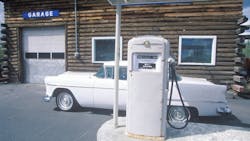
Back when gas stations had an auto repair component in the 1950s and 1960s, the owner was likely the jack of all trades—mechanic, fuel filler, cashier, and customer service representative.
Even as automotive repair shops shifted into their own buildings with multiple bays, the owner still showed up at that location every day, determined to make a living for himself and his team.
These days, as owners age out of the industry and look at options to cash out, many are considering alternatives to selling to their competitor, such as private-equity firms. Although the financial aspects are appealing, Marconi says he has concerns about how it will affect the industry.
I get the X’s and O’s and the numbers, but they’re not going to duplicate what that shop owner does in the community,” he points out. “They’re supporting the Little League, they’re supporting the cheerleaders, they’re supporting the dance club, they’re supporting everybody in the blood drives, all the heart walks. Those are the shop owners that are in the community. When a private-equity group buys that shop, are they really interested in maintaining it? No, they’re not. So private equity will be a major force in the next 10 years. I just don’t know if it’s a good thing.”
Get a Handle on Your Shop
Whether they’re for the better or not, changes are inevitable. To survive the next revolution, Morsli and Marconi recommend keeping it simple.
“Know your numbers and what they should be,” Morsli advises. “Because without profits, you’re not going to be able to make it. You’re not going to be able to grow. You’re not going to be able to do the things that you need to do. So definitely take the time to look at your numbers, know your numbers, and plan accordingly.”
Marconi zooms out even further on his lens of simplicity: “Take care of your employees, take care of your customers,” he urges. “Because they are the lifeblood to your legacy.”
Different Decades, Same Reality: The Numbers That Run Auto Repair
In 1982, the average hourly earnings for a mechanic were between $6.80 and $10.82, depending on the region of the U.S. you lived, according to the U.S. Bureau of Labor Statistics. In 2016, the bureau reported hourly earnings of $20.33 in January 2016 to $20.55 in December 2016. Shop owners Joe Marconi and Karim Morsli experienced dramatically different economic climates when they entered the world of auto repair shop ownership (note Marconi first opened his shop in 1980, but exact statistics were unavailable). No matter the era, the numbers always govern auto shops.
Here are some of the numbers many of you still focus on today through the lens of time:
Average Repair Order
1980: $75-$100
2016: $450-$700+
Source: CarMD Vehicle Health Index
Average Labor Rate
1980: $25-$40
2016: $100-$150
Source: American Automobile Association
The Evolution of Car Repairs
When it comes to keeping cars rolling down the road, repairs have transitioned from mechanical fixes and troubleshooting to technical software issues and diagnostics. Here’s a look at some of the most common issues in cars in 1980 and 2016 when Joe Marconi and Karim Morsli entered the market respectively.
|
Category |
1980 |
2016 |
|
Engine |
Carburetor tuning |
Sensor & ECU diagnostics |
|
Ignition |
Points, plugs, timing |
Coil-on-plug systems |
|
Fuel system |
Mechanical pumps |
High-pressure electronic systems |
|
Brakes |
Drums & manual adjustments |
Disc, ABS, electronic parking |
|
Diagnostics |
Visual & mechanical |
Scan tools & software |
|
Electrical |
Minimal wiring |
Networked control modules |
Source: Consumer Affairs
About the Author
 Christine Schaffran
 Christine Schaffran
Editor-in-Chief
Christine Schaffran is the Editor-in-Chief for Ratchet+Wrench magazine at Endeavor B2B. She is an award-winning journalist, having covered both commercial and industry magazines and newspapers during her career. She previously served as Editor-in-Chief for another publisher for 17 years prior to joining Endeavor. When she's not spending time with her husband and son, you'll find her in the kitchen experimenting with new recipes and delicious dishes to try.
Don't miss Christine Schaffran's next article. Sign up for Ratchet+Wrench's Insider and This Month in Ratchet+Wrench's newsletters.