Maximizing Efficiency: Strategies to Boost Profit and Customer Satisfaction
Key Highlights
- Implement digital inspections and meticulous record-keeping to enhance transparency and build customer trust.
- Use a dedicated inspection bay (rack attack) to ensure quick vehicle intake and prevent delays in service.
- Adopt flexible bay usage by removing technician-specific designations, allowing for dynamic workflow and faster turnaround.
- Maintain a comfortable work environment with air conditioning and good lighting to improve employee satisfaction and productivity.
- Prioritize clear, frequent communication with customers through check-ins and updates to foster transparency and loyalty.
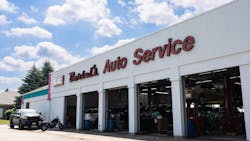
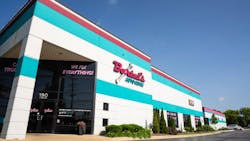

Organization from the front of the shop to the back does more than streamline communication—it increases workflow and ultimately, your ability to turn a profit.
“We all know the process,” says Tim Swiontkowski, owner of Stellar Autoworks in Plymouth, Minn. “Get the cars in, get them looked at, get parts on the way, get them fixed, get them out the door. There's not a lot more to it than that.”
However, if you routinely experience bottlenecks and delays in parts deliveries, or fail to utilize technology to assist your operation, you could feel the effects in everything from morale to the inability to monetize your efforts.
So, what are the best ways to maximize efficiency and minimize downtime? Two shop owners share some of their best tips for increasing customer satisfaction while making sure employees remain productive in the bays.
Seamless Processes
When it comes to delivering the best experience for customers, Swiontkowski says, nothing beats a good process.
“I think it's pretty common practice from what I've seen, but maybe there's shops out there that aren't doing digital inspections,” he notes. “I think that's probably one of the best ways to provide transparency.”
He adds that meticulous notes and records also go a long way not just in making sales, but in establishing a rapport with customers for long-term relationships. To achieve this, Swiontkowski says each of his technicians has a tool cart with a built-on tabletop that hides a secret weapon—a laptop with a battery-backup power strip to record every vehicle’s evaluation and diagnosis.
To keep the lines of communication open between technicians and service advisors, a shop management system is utilized for customer interactions while Slack is the platform of choice for internal odds and ends, such as low shop supplies or waste pickups.
Meanwhile at Bartel’s Auto Clinic’s three shops in the surrounding Chicago area, Amy Bartel’s secret sauce involves a single bay and a process that ensures every vehicle makes it through the door to be examined the day of the customer’s initial request.
It begins with the rack attack.

Streamlined Workflow
Bartel, a fourth-generation co-owner along with her brother, Adam Bartell, says their rack-attack concept has been an absolute game changer in their communication with customers who are typically in a panic when they call to report an issue with their vehicle.
“They're there because they're at the doctor's office. They want to know what's wrong with their vehicle,” Bartel explains. “Why is my car presenting with this symptom?”
To address concerns as quickly as possible, bay one is reserved only for vehicle inspections, which are expected to take about 15 minutes. From there, the vehicle is triaged and assigned accordingly. Bartell notes this one adjustment in their process has allowed them to never turn a vehicle away from being seen on demand.
“In bay one, the rack attack bay, there's absolutely no work being done that is an inspection bay only,” she stresses. “So, no matter what, when that phone rings, I can tell a customer, ‘I can get you right in.’ Always having that bay space available to bring a vehicle in has astronomically increased our efficiency and getting vehicles in and out.”
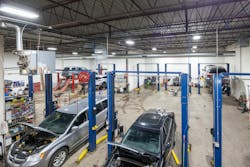
With nine bays and only three technicians in a 9,000-square-foot warehouse space, Swiontkowski describes himself as a “bit of an oddball” when it comes to the workflow formula that best addresses customers’ needs. Since each technician can spread out their work over three bays, Swiontkowski says the cadence of the day is more important in his case. For this reason, all vehicles are morning drop-offs by appointment only.
“Everybody just drops their car off just wanting an oil change, but we know better. For us it comes down to appointment management and knowing that our average repair order is going to end up being north of $500,” Swiontkowski explains. “So, if we’ve got these eight cars in here for the day, let’s spend the time we need to and manage our workflow that way. And we can probably count on half of them getting some significant work done.”
He adds that while he does occasionally assist his technicians, he is most focused on his marketing efforts.
“I don't want to let up off of the marketing because I feel like that is the no. 1 way to create workflow and efficiency is by making the phone ring,” he explains.
Productive Layout
And while most might consider investing in overhauling a space to improve traffic flow or make tools more centrally accessible, Swiontkowski encourages shop owners to think outside the box.
“One of the things I found that really helps with efficiency and employee satisfaction is I air conditioned my shop,” he notes. “So, it's air-conditioned, it's heated, it's well lit. I try to keep everybody comfortable because comfortable employees are happy, and happy employees make for happy customers.”
Bartell agrees a small shift in thinking can make all the difference. In their case, it meant removing the distinction of designating bays for individual technicians.
“I think the auto industry mentality is, ‘This is Joe's bay. This is Tyler's bay. This is Phil's bay.’ When we do that, we're cutting productivity just by designating a bay. So, the biggest shift that we've made is these are all our bays. We're all working as a team. We have plenty of cars coming in, so there's no reason that I’ve got any technicians that are starving.”
Bartell adds being able to flip cars out of bays like restaurants flip tables if a job stalls while waiting on parts is another benefit of getting away from the designating bays game.
“There's a reason that technicians come with carts, right? You can move that cart to any bay around the shop. There's no reason that you need to have a designated bay,” she asserts. “So, I think that that first and foremost is huge in bay efficiency. If I'm waiting on parts, get that car out of the bay and get another car in the bay.”
Respond to the Emergency
Ultimately, Bartell says, the speed of communication is going to make or break your operation.
“At the end of the day, it’s about speed of service, not speed of repair,” she points out. “I think that’s a big misconception in the industry.”
Check-ins at 10 a.m. and 2 p.m. not only routinely deliver updates so customers know what is happening with their vehicles, but ironically it, too, helps with workflow.
“It is directly tied to how efficient the shop is because now you don't have problems with customers calling and going, ’Well, you promised me this, and you're not delivering,’ right? Instead, we under promise. We over deliver,” she says. “If we are communicating with the customer, and they know exactly what's happening multiple times throughout the day, they're more confident in our repairs, and they’re more confident because of our transparency.”
Like any good repeatable process, the results are measured by your ability to turn one-time customers into lifelong patrons of your business.
“Everything comes back to the hospitality piece of the customer, waving that white flag, and us being here to help, and seeing how quickly we can get to servicing them and helping them,” Bartel says. “We operate as auto hospitality. We are here to solve any of your problems.”
As such, Bartell likens their approach to being the ambulance that responds to a customer’s emergency in their time of need.
“I know when my check engine light comes on, I've got a problem, and that's generally the general public, right? They have no idea what's going on, so they are literally calling in an S.O.S for help,” she notes. “So, what do we have to do to help them take it off of their plate and to get it into our shop as quickly as possible? And most of the time, creating that sense of urgency also iterates to the customer, ‘Not only is your problem important to me, but I will do anything I can to help’.”
About the Author
 Christine Schaffran
 Christine Schaffran
Editor-in-Chief
Christine Schaffran is the Editor-in-Chief for Ratchet+Wrench magazine at Endeavor B2B. She is an award-winning journalist, having covered both commercial and industry magazines and newspapers during her career. She previously served as Editor-in-Chief for another publisher for 17 years prior to joining Endeavor. When she's not spending time with her husband and son, you'll find her in the kitchen experimenting with new recipes and delicious dishes to try.
Don't miss Christine Schaffran's next article. Sign up for Ratchet+Wrench's Insider and This Month in Ratchet+Wrench's newsletters.