How to Talk to Your Customers About ADAS Calibration
Key Highlights
- Use OEM service manuals and position statements to frame ADAS calibration as a manufacturer requirement, not an upsell.
- Normalize calibration by presenting it alongside other services like alignments, explaining the safety and technical reasons clearly and concisely.
- Connect calibration to real-world driving experiences, such as adaptive cruise or lane warnings, to help customers understand its importance.
- Utilize visuals like OEM excerpts, animations, and photos to simplify explanations and build credibility without overwhelming customers.
- Train service advisors to communicate confidently and consistently, linking technician notes to customer language, and emphasizing the safety-critical nature of calibration.
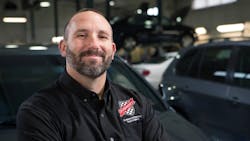
Advanced driver-assistance systems (ADAS) are now routine in repair tickets – from a post-collision radar aim to a camera calibration after an alignment or windshield replacement. Yet for many motorists, the line item still reads like an unfamiliar upsell. Two veteran shop leaders – Matt Fanslow, shop manager at Riverside Automotive in Red Wing, Minn., and Tom Schearer, owner of Schearer’s Sales & Service, Allentown, Pa., and Ratchet + Wrench’s 2024 All-Star Award Winner – share how they explain the work, price it confidently, and keep the conversation focused on safety and OEM procedure.

Lead with the OEM, Not Opinions
Fanslow’s first principle is simple: the service manual is the script.
“If a manufacturer says, ‘replace this part, then calibrate this sensor,’ we have to do it,” he says. “That doesn’t always mean step-by-step hand-holding in the manual, but the end goal never changes: the targets and equipment must be placed exactly where they need to be, accurately.”
He keeps it concrete by showing customers the published procedure or position statements. It shifts the dialog from “our recommendation” to “the vehicle maker’s requirement,” which also reframes price questions. “The equipment, the targets, the annual updates – there’s real cost and maintenance behind doing this right,” Fanslow notes. “Like any business expense, you have to recoup it – and yes, make a profit.”
Normalize the Line Item
Schearer has learned that making ADAS sound exotic can backfire. “We present calibration just like any other needed service,” he says. “Along with your four-wheel alignment, we’ll calibrate the vehicle’s cameras for your safety systems. Then we move on.”
When customers do ask why calibration costs more than an alignment, he keeps the answer short and specific: adjustments change reference points; today’s vehicles use cameras and radar that must be recalibrated to those new reference points; that takes time, space, tooling, and precision. “We’re upfront and transparent, but we don’t dramatize it,” Schearer says.
Connect the Tech to What They’ve Felt Behind the Wheel
Pushback usually stems from an education gap. Many motorists don’t realize their car even has ADAS, Schearer says. His team bridges that gap by naming familiar features:
- Adaptive cruise that slows in traffic
- Lane warnings (beeps or steering wheel feedback) at the yellow line
- Forward collision/automatic braking alerts.
Once customers connect those experiences to the sensors you’re calibrating, the need makes sense. Fanslow adds a vivid mental model: a camera that’s off by a fraction of a degree may be “inches off” a few feet ahead – but feet off hundreds of yards down the road, potentially reading the wrong target. That framing sticks.
Show, Don’t Just Tell
Both leaders use visuals to keep explanations tight and clear.
- Printed/OEM excerpts: A snippet of the procedure that ties the calibration to the repair performed (e.g., alignment with thrust angle change).
- Short animations: Schearer’s team attaches MotoVisuals clips to estimates – what an alignment does, why calibration is required afterward.
- Screens/photos: Images of the target setup or a quick scan report add credibility without overwhelming the customer.
Fanslow also shares third-party resources when helpful (vendor explainer videos; safety organization overviews). “People may not like the price,” he says, “but once they understand it’s safety-critical, they don’t hesitate.”
A Story Beats a Lecture
A concrete case study can be the turning point. Schearer recalls an Audi whose driver felt intermittent brake pulsing and saw a brief “front assist limited” message. A windshield had been replaced a week earlier, and the customer had been told the camera would “recalibrate as you drive.”
On a road test, the team verified the pulsing, scanned the vehicle, and performed a proper static calibration. The symptoms were resolved. “When she connected the timing to the glass work, it clicked,” Schearer says. “It’s a reminder to trace recent work and verify OEM steps were actually followed.”
Fanslow shares the opposite scenario: a driver who refused calibration after a repair despite clear documentation that it was required. His shop had the customer sign the RO and towed the vehicle home at the shop’s expense – a line-in-the-sand decision based on safety and liability. “If we let them drive out, it could imply the car is safe,” he says. “In today’s litigious environment, we couldn’t take that chance.”
Train Advisors to Speak Human
Service advisors don’t need to be techs, but they do need to be fluent in the why, able to translate technician notes into customer language, and consistent from counter to counter.
Schearer builds that consistency through Shift Point Training Academy (founded by his daughter, Samantha, the 2024 AAPEX Service Advisor of the Year), plus lunch-and-learns, “in-the-moment” coaching, and tight tech-advisor feedback loops. “Every client should get a similar, confident explanation of what’s needed and why,” he says.
Fanslow points advisors to equipment-maker resources (Autel, Hunter, Bosch, Snap-on, Launch) and emphasizes linking the calibration to the operation performed. Example: “We completed your alignment; the manual says if thrust angle changes, we must calibrate the forward camera for the safety systems to function properly.”
Price It Like It Matters – Because It Does
Both owners stress pricing discipline. Calibrations require space, targets, specialized tooling, software subscriptions, and ongoing updates. “Remember your worth,” Schearer says. “Don’t devalue the work – or the industry – by discounting or treating it as an afterthought.” Fanslow agrees: document the OEM requirement, perform the calibration to spec and retain proof of completion.
Bottom Line
Treat ADAS calibration as standard of care, not a debate. Normalize it in estimates. Tie it to the OEM requirement and the customer’s real-world safety. Use visuals to keep explanations short. Train advisors to be consistent and confident. Price and document the work like the critical procedure it is.
Do that, and most customers will move from skeptical to satisfied – because they understand what they’re buying and why it matters on the road.
A Simple, Repeatable Talk Track
Equip your front-of-house with a concise script they can make their own:
- State the need plainly. “Because we adjusted your vehicle’s geometry, the manufacturer requires a camera/radar calibration, so your safety systems work properly.”
- Anchor to the OEM. “Here’s the procedure that ties calibration to this repair.”
- Connect to lived experience. “This is what enables your adaptive cruise/lane keep/automatic braking to behave correctly.”
- Set the expectation. “It takes precise setup, targets, and software to do this to spec. We’ll handle it end-to-end and document the results.”
- Invite questions – briefly. Use an animation or photo if needed; avoid a tech lecture.
About the Author
 Leona Scott
Leona Scott
With extensive experience in the auto care industry and working for nonprofits, Leona D. Scott has dedicated years to crafting compelling content for print and digital platforms. In 2018, she began JEP Marketing Communications LLC, primarily providing tailored content marketing solutions for publications and membership-based organizations.