Artificial Intelligence: A Game Changer for Euro Car Doctor’s Predictive Maintenance Work
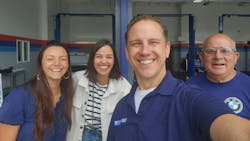
Tony Perez has always been interested in technology. Whether it’s for cars or computers, he wants to understand it and how it will impact his California repair shop, Euro Car Doctor, which has locations in Irvine, Costa Mesa, and an upcoming store in Orange County. Perez has sought something that would help him streamline the process of identifying each and every need a car has and has made a breakthrough with the implementation of artificial intelligence.
Now, service writers have a fast process for cross-examining a vehicle’s service history with manufacturer recommendations and breaking it down based on priority for a customer, leaving more room for what matters: communicating and building trust. When team members follow each step of the new process he’s outlined, they see success that’s consistent throughout his multiple locations.
Streamlining Predictive Maintenance
The goal with implementing AI was to find more opportunities to sell maintenance jobs to customers, rather than only helping them with urgent needs as they arise. He researched different tools to find something that could easily make recommendations based on a vehicle’s service history.
Currently, Perez’s shops use a tool that pulls data from manufacturer databases and CARFAX. Before appointments, the shop collects info like license plate numbers and VINs, which the AI tool uses to find info on the car. The vehicle’s service history is compared against manufacturer maintenance schedules, preloading overdue and upcoming service items that are displayed during a customer’s appointment.
Perez uses my 2011 Toyota Camry as an example of how this process typically plays out with a customer.
“Your Camry comes in, but before it shows up, I trained all of our service writers at all of our stores to literally say, ‘I’m glad you’re coming in tomorrow for an oil service. Looking forward to seeing you again. Since this is your first visit, would you mind if I get your license plate or your VIN number so I can do the history research on the work you’ve done to your car?’” Perez explains.
Throughout all of this, service writers are reminding customers that the shop will not recommend anything they don’t need. While that has always been the case, having a tool that generates comparisons between the service received and the manufacturer’s recommendation has resulted in many more customers saying yes. Why? Because when they can see for themselves what their car needs in order to be safe—according to the manufacturer itself—then they have more trust in your guidance.
The shop continually reminds customers of this, with service writers stating that they will not recommend anything that isn’t necessary. But to drive the point home, when a customer comes in for their appointment, the shop categorizes different vehicle needs into colored labels, depending on the severity of the issue. Red represents urgent needs, while green highlights jobs that aren’t essential at the moment.
“With AI, it gives everything in red that needs to get done or is past due; everything in gray that’s going to be due within the next oil change; and everything that’s in green doesn’t need to be done,” says Perez.
This allows customers to understand the state of their vehicle, and to have the option of only having urgent needs met or going ahead and having it all done.
Standardizing Communication
For service writers, they’ve also had a lot of trivial work lifted off their shoulders. With AI automatically pulling data on the vehicle’s service history and manufacturer databases, employees can immediately have the info they need to communicate with customers. Especially in a time when it can be difficult to recruit service writers, this tool can make it easier for people to transition into the role.
In addition to compiling service history, the AI tool can also provide rebuttals for service writers, based on a customer’s needs and budget, and will provide prompts and questions for service writers to ask customers, enabling the technicians on the shop floor to have a clearer picture of what’s wrong with the vehicle.
“It capsulates all those questions and summarizes it,” says Perez. “Check engine light started a month ago, only happens for 15 minutes at startup, and you can only feel the vibration at high speeds on the freeway; this only happened after a recent visit for brakes at the dealership. It summarizes that whole packet. So, when the technician gets it, he’s not reading ‘diag,’ he’s reading, ‘The client states X, Y, and Z.’”
“I gave him the golden tool—he knows exactly what to go look for and exactly how to replicate it, because the AI asked it that way; not ‘diag on the freeway at high speeds.’”
Shops like Euro Car Doctor get lots of phone calls and voicemail messages; but some are more urgent than others. Every call taken at the shop is recorded, and AI has the capability to detect if a customer starts yelling, uses certain trigger words, and similar reactions. That recording is then flagged, and sent to Perez’s inbox, allowing him and the whole team to remedy the situation before a customer’s car even leaves the shop. Additionally, it collects data on what issues customers aren’t returning to the shop for, which can help shops that are trying to boost client retention rates.
“Tools like this help you see why the customers are not coming back. Because what you feel is what you feel. That may or may not be the actual reality,” Perez says.
A Tool to be Used Mindfully
The process works seamlessly, as long as a service writer follows each step. It’s crucial to remind the customer, at least twice, that they will not be recommended anything they do not need.
“You identify twice—they need to hear it two times—that we will never recommend anything your vehicle does not need. I need to psychologically start to program this in your mind,” says Perez.
Because that’s precisely what the shop’s prescribed process does: it identifies everything in the car that needs attention, and divides each area based on urgency. Service advisors are meant to focus on top priority jobs: things that could impact the safety of the vehicle, such as worn brakes or a leaky water pump. But if this step is skipped, and customers are presented with a laundry list of components to have replaced, they may become overwhelmed and leave.
When that’s followed, customers don’t feel like they’re having a myriad of random jobs dumped on them, but rather that the shop is attuned to every part of their vehicle and is helping guide them according to their needs and budget.
“You may not want to do it right now, so let’s tackle the priority ones first, and they’ll come back in a couple of months and do the priority twos,” explains Perez. “When that’s not presented, customers are like, ‘You just tried to sell me a smorgasbord of things.’ … What a difference of an environment somebody has coming to you, getting this information data dump, me telling you that we will never, ever recommend something you don’t need, and then telling you what’s a priority and what’s not.”
About the Author
 Kacey Frederick
Kacey Frederick
Associate Editor
Kacey Frederick joined as the assistant editor of Ratchet+Wrench in 2023 after graduating from the University of Arkansas at Fort Smith with a bachelor’s in English and a minor in philosophy.
The grandchild of a former motorcycle repair shop owner, he’s undergone many trials and tribulations with vehicles. Now the proud owner of a reliable 2011 Toyota Camry, he works to represent those in the repair industry that keep him and so many others safely rolling on.