What the 53% of Shops Without Online Scheduling Are Losing Per Bay Per Month
Key Highlights
- 53% of shops still schedule manually, quietly losing revenue to no-shows.
- Automated reminders recover roughly $1,400 per bay per month.
- Most shops already text customers, only the scheduling layer is missing.


Most shop owners can tell you their car count off the top of their head. But there's a number hiding right behind it that quietly drains your month, and it never shows up on a dashboard: what those no-showed slots are really costing you.
According to the 2026 State of the Market report from Ratchet+Wrench and AutoZone, only 47% of independent repair shops use an online appointment and scheduling system. That means 53%, the majority, are still booking by phone, by paper, or by some combination held together with sticky notes and memory.
Here is the part that should sting: the same report found that 69% of shops already communicate with customers electronically through text and email. The hard part, building a digital line to the customer, is mostly done. The piece that turns those messages into kept appointments is the one most shops are still missing.
That gap has a number attached to it. This article breaks down the exact cost, per bay, per month.
The No-Show Nobody Budgets For
A no-show is not a neutral event. It is a bay that sat empty, a technician who lost billable hours, and a slot that could have gone to a paying customer who wanted in.
Across the industry, around 10% to 15% of booked appointments never happen. Many shop owners see this as just part of the business. But the good news is that it's one of the easiest problems to fix.
You don't need more customers, higher labor rates, or extra repair jobs to recover that lost revenue. Small changes to how you confirm and manage appointments can help keep your bays full and your schedule running smoothly.
The fix is super easy: automated appointment reminders. When a booking automatically triggers a confirmation, a reminder a day or two out, and a nudge the morning of, customers stop forgetting. The drop can be dramatic.
AutoLeap customer data shows no-show rates falling from 50% to 10% for shops that switched to integrated scheduling with automated reminders. Even a far more conservative shop, running a 15% no-show rate on paper, can realistically pull that down to around 9%, not by chasing people on the phone, but by letting the system do the chasing.
Six percentage points sounds small. Run it through a single bay, and it stops sounding small.
The Per-Bay Math
Start with throughput. U.S. shops service an average of 2.2 vehicles per bay per day, according to the 2025 State of General Auto Repair Shops report from PartsTech, which surveyed more than 750 shops. Across roughly 24 working days in a month, that is about 53 appointments per bay.
Now apply an average repair order. General repair shops typically run an ARO between $400 and $550, with the most commonly reported band landing between $500 and $749. We will use $450 here, deliberately below the midpoint, so the model understates the loss rather than inflating it.
Here is what each no-show rate costs that one bay every month:
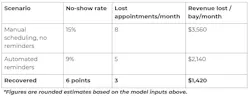
That is roughly $1,420 per bay, per month in revenue that was already on the books and simply walked out the door. Annualized, it is about $17,000 per bay per year. For a four-bay shop, you are looking at close to $68,000 a year in repair orders that were booked, then lost, then preventable.
Run leaner numbers and the loss is still real. At a $350 ARO and a tighter 10% baseline no-show rate, the recovered figure still lands near $740 per bay per month. The number moves with your inputs. It never rounds to zero.
'We Already Called to Confirm' Is Not the Same Thing
Many shops still remind customers about upcoming appointments with a phone call, and for years, that worked well. The problem isn't the reminder; it's how people answer their phones today.
Most people ignore calls from numbers they don't recognize. According to Hiya's 2024 State of the Call report, 92% of consumers assume an unknown call could be spam, and nearly half of those calls go unanswered. That means even a legitimate reminder from your shop may never reach the customer.
Text and email reminders work better because they're how customers prefer to communicate. A quick text is easy to read, and customers can confirm or reschedule in just a tap. Better yet, automated reminders make sure every customer gets the same experience without adding more work for your front desk.
There's another benefit, too. Online scheduling helps fill your calendar before no-shows even become an issue. Instead of waiting until your shop opens, customers can book an appointment whenever it's convenient—even at 9 p.m. on a Sunday. That means fewer missed booking opportunities and a fuller schedule.
When you combine online scheduling with automated reminders, you're not just reducing no-shows. You're making it easier for customers to book, confirm, and keep their appointments.
Put Booking Where Customers Are Already Looking
Having online booking isn't enough. It needs to be available where customers are already searching for a shop, on your website and your Google Business Profile.
When someone decides they need a repair, they want to book it right away. If they have to wait until business hours to call, there's a good chance they'll move on to another shop. In fact, a GetApp survey found that 59% of people find scheduling by phone frustrating, and 95% are more likely to choose a business that offers online booking.
Just as important is what happens after the customer books. If appointments have to be entered into your schedule manually, you're creating extra work and increasing the chance of mistakes.
An integrated booking system removes those extra steps. For example, shop management software like AutoLeap lets customers book directly from your website or Google Business Profile, and every appointment automatically appears in your shop's calendar with the customer's information already attached. No double entry, no scheduling conflicts, and no missed opportunities.
Where Customer Expectations Are Already Headed
If there is a reason to treat this as urgent rather than optional, it is generational. The report found that while 69% of shops overall use electronic communication with customers, that number jumps to 87% among shops run by owners aged 25 to 40. The same younger group is using online marketing tools well above the industry average.
That is not just a story about which owners are more comfortable with technology. It is a preview of what customers expect. Drivers already book the dentist, their haircut, and the restaurant table from their phones at all hours. The shops adapting to that behavior fastest are the ones being run by the operators who grew up with it, and they are setting the bar that their competitors will eventually have to meet.
What the Shops That Switched Describe
Owners who have closed this gap tend to describe the change less as a revenue event and more as a quieter front desk. Bays stay full because slots get booked around the clock and confirmed automatically. Service advisors spend their time advising instead of dialing. And the no-show rate becomes a number on a dashboard that trends down.
This is the workflow that shop management platforms with built-in online scheduling and automated reminders are designed to run, tying online booking, automated reminders, and the repair order into one system, so a confirmed appointment flows straight into the work that follows it. The task stops depending on whether someone at the counter has a spare minute.
The Bottom Line
If your shop is in the 53% still scheduling manually, the cost is not hypothetical, and it is not industry-average hand-waving. It is roughly $1,400 per bay per month in repair orders you already earned and then lost to a forgotten appointment. Multiply by your bay count. Multiply by twelve.
The 47% who made the switch did not find new customers to close that gap. They just stopped letting the ones they already booked slip away.