Parnell: The Compound Effect of Small Actions: Why Discipline Trumps Motivation

Discipline Trumps Motivation
By Josh Parnell
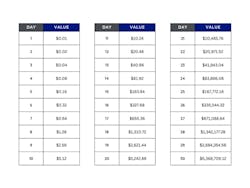
Would you rather have a penny that doubles in value every day for 30 days or a million dollars, tax-free, cash in hand, right now? One cent today becomes two cents tomorrow, four cents the next day, eight cents on day four, and so on. Most people instinctively choose the million. But by day 30, that penny is worth over five million dollars.
The catch is that the growth doesn't look impressive, at first. On day 10, you only have $5.12. Even on day 20, it is just over $5,200. The real explosion happens in the final stretch, when momentum and the power of the compound effect collide. Once it takes off, it doesn’t slow down.
That’s life. Real change works the same way. Small, consistent actions compound over time, even when progress feels invisible early on.
As we step into 2026, many of us are deep in the uncomfortable phase of implementation, trying to follow through on goals that felt exciting just weeks ago. We’re navigating behavior change, habit formation, and the frustration that comes with both.
James Clear, author of “Atomic Habits,” says that habits are the compound interest of self-improvement. Whether we’re talking about habits or daily choices, consistency is non-negotiable for meaningful change.
A Familiar Cycle
Every year, the most common New Year’s resolution is some version of losing weight and eating healthier. So let us put ourselves there and walk through how this typically plays out.
First, we buy a gym membership. This is it. We’re committed. That squat rack is about to become home. Then we buy new gym clothes because if we look good, we’ll feel good. And then we’ll need new shoes, of course, because “science” says they make us faster.
Next come the supplements—protein powder, creatine, pre-workout—they’re all essential. Then we find a treadmill on Craigslist. Boom. We snag that, too, and the home gym is unlocked.
We clean out the fridge and pantry and replace everything with organic, grass-fed, non-GMO, sugar-free foods that taste suspiciously like cardboard, but we grin and bear it because THIS year it’s a new year and a new me! Sacrifice builds character.
Now it’s time to actually work out.
Week one feels great. We’re motivated. Waking up early isn’t that bad. Meal prepping is manageable. We start thinking that we’re really going to do it this year. We’re going to get that six-pack we’ve been longing for.
Week two rolls around. Still going strong, but life happens. We didn’t meal prep, we’re working late, and Chick-fil-A ends up being dinner. It’s fine. Let’s be real, those employees are like angels on earth. Chick-Fil-A is the Lord’s meal, and it's our first fried food in weeks.
By week three, we’re tired. We skip a workout to sleep in. No big deal. It’s just one. We’ll get back tomorrow.
Before we know it, February arrives. We’re at the gym once a week, meal prepping is a distant memory, and that treadmill has become a very expensive clothes rack. What happened?
The problem is not motivation. It’s discipline, or a lack thereof. We overestimate what we can accomplish in a month and underestimate what we can accomplish in a year.
The compound effect of small, consistent actions doesn’t show up overnight. Sometimes it doesn’t even show up in six months. But the question is “What happens if we keep going anyway?”
Too often, we quit right before the breakthrough. We’re closer than we think, but we stop before the results have time to surface. Instead of celebrating progress, we end up celebrating something else entirely. Quitter’s Day.
Yes, Quitter’s Day is a real thing. The second Friday in January marks the point when over half of people who had New Year’s resolutions have already abandoned them. Two weeks in, and it’s over.
If we had stopped doubling the penny after two weeks, we wouldn’t have even reached $100. If we had stayed the course for two more weeks, we would have crossed the million-dollar mark.
Most people don’t quit because they’re incapable. They quit because they don’t give themselves enough patience, grace, or understanding to grow. And they’re unwilling to do the small, repetitive, boring actions that ultimately yield incredible results. We assume habits should be easy and results should come quickly.
Work Through the Dip
But research tells a different story. A 2009 study in the European Journal of Social Psychology found that habit formation can take anywhere from 18 to 254 days. James Clear puts the average at 66 days. He also reminds us that habits are not a finish line to be crossed. Rather, they’re a lifestyle to be lived.
This is where the concept of the J-Curve is important to understand. Imagine the letter “J.” When we start something new, whether it’s a habit, behavior, or process, we begin at the bottom. Change feels awkward, challenging, and uncomfortable. But we want to embrace that discomfort because growth and comfort can’t coexist.
Early on, we should expect a dip in productivity, confidence, and results. Most people don’t fail because the change doesn’t work. They fail because they’re not prepared for the dip.
They quit before they learn what’s working. They quit before compounding has a chance to do its job.
My encouragement is simple. Do not quit in the dip. You have to go through it to grow through it.
There will be obstacles, mistakes, and setbacks. But the other side of the “J” is always higher than where you started. If you stay consistent long enough, the results will come. Just like the penny, the payoff is closer than you think.
About the Author

Josh Parnell
Josh Parnell is the Founder and CEO of Limitless Leadership LLC. He is an experienced leadership coach, trainer, and speaker in the automotive repair industry and a United States Air Force veteran with over 20 years of leadership experience.
Prior to entrepreneurship, he grew and developed his leadership skills as a corporate trainer and coach for Christian Brothers Automotive, where he led a TEAM for nearly a decade that served thousands of employees within the franchise organization.
Josh is the host of the Limitless Leadership Podcast and enjoys traveling, reading, cooking, and working out. He's married to his wife, J’anvieu, and together they are raising leaders in their four children at home in Houston, Texas.
For more information, please visit limitlessleadership.co.