Teaching Tomorrow's Technicians Without Forgetting Yesterday's Lessons
Key Highlights
- Fundamental skills, especially electrical systems, are essential for troubleshooting modern vehicle technologies effectively.
- Technicians are now more than mechanics; they are electricians, diagnosticians, and IT professionals, requiring a broad skill set.
- Learning methods are shifting towards tactile and visual approaches, with instructor-led training and hands-on experience being highly valued.
- Strong communication skills are vital for diagnosing intermittent problems and explaining issues to customers through tools like digital video inspections.
- Lifelong learning is necessary in the automotive industry, with ongoing training and revisiting core concepts to stay current with technological advancements.

Technology is changing faster than technician education ever has—but educators say the biggest challenge isn’t learning new technology. It’s mastering the fundamentals that make every new technology work.
That message came through consistently from three educators working at different levels of the industry. Brandon Steckler, owner of S.W.A.T. Training and Diagnostics, trains working technicians across the country. Matt Shepanek, vice president of credentialing at the National Institute for Automotive Service Excellence, helps shape the industry’s certification standards. Brian O’Leary, an automotive technology instructor at Moore Norman Technology Center, prepares students to enter today’s repair shops. Despite their different roles, all three reached the same conclusion: the future of technician education isn’t about choosing between foundational skills and emerging technologies—it’s about using one to support the other.
“Although we want to stay with the times and we want to keep changing our curriculum to match the new technology, we still have to stick to the fundamentals because without those fundamental tasks and mastering those fundamental tasks, we’ll never be able to prepare a student well enough for the newest technology,” says O’Leary, who teaches students hoping to enter the industry at the Oklahoma campus.
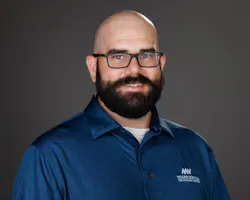
While there has been an emphasis on ADAS, EVs, and other emerging technologies, particularly in recent years, Steckler agrees there is still something to be said for basic mechanical aptitude.
“The technicians that lack the basics are the ones that are going to struggle with the new stuff because all this new stuff still requires those basic operating principles,” he points out.
And just where should technicians focus their efforts? Across the board—one subject rose to the top for the educators—electrical systems.
“Electrical is definitely a foundational course that everybody should have a good understanding of,” Shepanek notes.
He adds the ripple effect it has on troubleshooting abilities surprises a lot of technicians.
“We’ll get this feedback every once in a while: ‘Well, I went and took the brake test, but man, there are a lot of electrical questions on it.’ Well, there’s a lot of electrical in the brakes now. You know, you have an ABS control module, and it’s … monitoring wheel speed sensors and all this kind of stuff,” he explains. “Basic electrical is still a foundation for many things.”
More Than a Mechanic
And while the basics are still important, they will only get you so far, O’Leary points out.
“Technicians are no longer mechanics. You’re electricians, you’re IT (professionals) and diagnosticians,” he says. “A lot of people say that you make … your money diagnosing. I’m not sure you make all your money diagnosing, but you can lose a ton of money and lose a ton of time misdiagnosing.”
Which is all the more reason why technicians need to hone their skills and balance old-school diagnostic skills with new technology, Steckler adds.
“You’ve got to be almost a jack of all trades now: electricians, vibration analysts, drivability specialists,” he notes. “All that old stuff is still there. It’s not going away. It’s just got varied layers of complexity.”
And the sharper the skills, the more technicians will be able to rely on them as the tides turn and new technology takes center stage.
“The engine is still the same old engine it ever was ... but there’s layers and layers of complexity that have been added,” Steckler says.
Teaching Has Changed—Learning Hasn’t
And just as important as what they’re learning is how technicians are learning, says Shepanek.
“Most technicians are tactile learners. They learn by touching and doing,” he explains.
Additionally, he says, there is a demand for instructor-led training instead of virtual learning and webinars, which became necessities during the COVID-19 pandemic.
“A lot of times, you can read about it, you can watch the video, but when you actually go to a class and you have a part that you can touch and open up and take a look inside of it, that’s when it all kind of comes together,” Shepanek notes.
Meanwhile, Steckler says virtual presentations and video animations have enhanced the manner in which instructors present materials to help “connect the dots” between classroom instruction and hand-on learning.
“Technicians tend to be visual learners,” he asserts. “Don’t tell me—show me.”
For his part, O’Leary is looking forward to applying a new visual he learned at the ASE Instructor Training Conference that uses pieces of string to explain how modules and computers in cars communicate across a vehicle’s network.
“It really dumbed it down to a level where the students can see the cross communication between all the different modules,” he marvels. “So, I’m going to use that in my classroom.”

Soft Skills Are Now Technical Skills
As for the frontrunner among the skills technicians can expect to lean on more and more? Surprisingly, Steckler says, it’s communication skills that come in handy when the dreaded “intermittent problem” rears its head for a customer and a technician must try to diagnose it.
“If you tell any technician they’re about to analyze a vehicle with an intermittent concern, they’re rolling their eyes and they’re huffing and puffing because intermittent concerns are very difficult to solve because not only do you have to find the problem, but you got to get the symptom to surface,” Steckler explains. “And half the battle is getting the problem to occur.”
However, the former technician notes that a short 10- to 15-minute interview with the customer may help to narrow the cause of the problem. For instance, a customer may say the issue occurs in the rain, which prompts Steckler to spray the engine compartment with a hose and “suddenly the car is acting up right there.”
“It’s not so much I do something more than other technicians. I wasn’t smarter,” he explains of the process. “I chose to get some more information from the customer, and most technicians will not want to talk to the customer because ‘They don’t have time to talk to customers. They’re here to fix cars.’ So, communication skills are not only absolutely crucial in your company, but also with your clients.”
When it comes to digital video inspections—another increasingly common tool in repair shops—O’Leary says those communication skills are also helping technicians to become the content creators that are needed to tell a good story.
“When these consumers watch those inspection videos, they’re not watching it to completion. They’re only watching 50% … if the technician is not grabbing the attention of the customer right away,” he explains. “And then if they’re not keeping their attention … the customer may miss valuable information.”

The Future Belongs to Lifelong Learners
When a student graduates from a technical school, they’re often surprised to learn that their educational journey is not over. In this industry, it’s never really over.
“You have to be a lifelong learner because the technology is advancing at such a quick pace that if you’re not staying on top of it with your training and everything, it’s going to pass you by,” Shepanek points out.
O’Leary agrees the lifelong commitment to training often comes as a shock to some.
“You don’t finish a program like ours and go into a shop and you’re done with schooling,” he says. “You will constantly take classes to maintain your training, your certifications, and your knowledge on vehicles.”
When in doubt on what to focus on, however, Steckler says technicians should return to the basics, even as you climb the ladder in the industry.
“If I want to commit it to memory, like tying my shoes, focus on the classes that apply to every vehicle,” he suggests. “That’s the type of training I want committed to memory. One that will help me on every car I work on.”
As vehicles continue to evolve, educators agree that the technicians best prepared for tomorrow won’t be the ones chasing every new technology—they’ll be the ones with a firm enough grasp of the fundamentals to adapt to whatever comes next.
The Benefits of ASE Certification
ASE Certification has long been considered the gold standard for technician training. While the list of certifications stretches from the most recent technological advances to the most basic skill sets, it may be difficult to determine where to focus technicians’ attention. Matt Shepanek, vice president of credentialing at the ASE Education Foundation, helps break down where to begin, what to concentrate on, and how to advance in the future.
Ratchet+Wrench: Are there any certifications that you feel are often overlooked, but highly valuable?
Shepanek: The big ones for us are A-Series. These are automotive series of credentials, so A1 through A8; those are really good foundational knowledge. And then we also have our advanced level test. So that's the L1 through L4, with L4 being one of our newest advanced level tests. That's on ADAS. And since ADAS is in something like 94 or 95 percent of all new vehicles produced today, it's important to stay on top of that because the ADAS systems are tied into the rest of the vehicle. So the networks, the ABS system, the engine control module, all of that kind of stuff. So that's all good knowledge to have.
RW: Do you think that every technician should pursue Master Technician status, or should it be more selective?
Shepanek: I think it depends on how big the shop is that you're working in, and what type of work (the shop does). In a lot of respects, the days of knowing everything—it’s getting harder and harder to have that level of knowledge. There are some people that do have it, but the cars are getting so complicated. So some people, if they can just specialize in a certain area and they've got plenty of that type of work coming in and they can make a good living on it, that’s fine. It all depends on the individual.
RW: How should independent shops decide which certifications to prioritize?
Shepanek: I think it's based on the type of work that they're taking in and … the area of the country that they're in.
ADAS systems are in almost all the new cars coming out right now. When they started out, they were real prevalent in a lot of the European cars starting almost 20 plus years ago, and so depending on the area of the country that you're in and what types of vehicles are out there, those are the kind of things I think you need to focus on.
Five Skills Tomorrow’s Technician Can’t Do Without
- Electrical fundamentals. Electrical knowledge is foundational to understanding today’s increasingly complex vehicle systems.
- Diagnostic thinking. Technology can provide information, but technicians still need to understand what that information means and avoid costly misdiagnoses.
- Technology literacy. Technicians need to understand how modules, computers, and vehicle networks communicate.
- Communication. Talking with customers can provide critical clues, particularly when diagnosing intermittent problems.
- Lifelong learning. As technology advances, technicians must continue training to keep their knowledge current.
About the Author
 Christine Schaffran
 Christine Schaffran
Editor-in-Chief
Christine Schaffran is the Editor-in-Chief for Ratchet+Wrench magazine at Endeavor B2B. She is an award-winning journalist, having covered both commercial and industry magazines and newspapers during her career. She previously served as Editor-in-Chief for another publisher for 17 years prior to joining Endeavor. When she's not spending time with her husband and son, you'll find her in the kitchen experimenting with new recipes and delicious dishes to try.
Don't miss Christine Schaffran's next article. Sign up for Ratchet+Wrench's Insider and This Month in Ratchet+Wrench's newsletters.