Key Highlights
- Tariffs have added unpredictable costs, especially for overseas parts, impacting shop margins and requiring strategic responses.
- Successful shops prioritize vendor relationships, challenge price increases, and push for transparent, straightforward pricing to control costs.
- Communicating value and quality to customers helps justify higher prices and fosters long-term loyalty in a price-sensitive market.
- Deferred maintenance and declining work volume highlight the importance of preventive care and customer education to avoid bigger future costs.
- Maintaining quality and sustainability over low prices is crucial; shops that focus on strong fundamentals and trust will better weather economic uncertainties.

For independent repair shops, tariffs didn’t arrive as a standalone challenge. They showed up after COVID-era shutdowns, supply chain whiplash, labor shortages, inflation, and a steady drumbeat of economic uncertainty that has made volatility feel like the new normal.
“(Tariffs) remind me a lot of COVID,” says Will Helton, owner of Arkatire LLC in Fayetteville, Arkansas. “You just have these macroeconomic disruptions in our business that nobody really signed up for, but we’re having to deal with.”
Across the country, shop owners are dealing with unpredictable pricing and customers who are more price-conscious than ever. Yet the most successful aren’t responding by cutting corners or racing to the bottom to sacrifice quality. Instead, they’re doubling down on vendor relationships, pushing back on price hikes where they can, and spending more time explaining value to their customers—both to protect their margins and keep customers for the long haul.
Where the Increases Hit First
For Chad Shelton, who owns Bailey’s Service Center in Shelbyville, Kentucky, the most noticeable tariff-related increases tend to show up in parts sourced overseas, especially for European vehicles.
“If it’s a special-order part coming from overseas, you may see higher shipping and stuff like that,” Shelton says. “For your all-makes-and-models-type parts, you’re not seeing it as much, but it’s definitely affecting everything.”
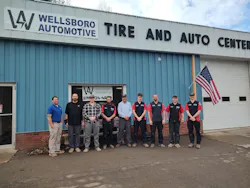
Jeff Furrow, owner of Wellsboro Automotive in Wellsboro, Pennsylvania, has seen those increases arrive faster and more forcefully than ever before in his 30-plus years in the industry.
“One instance that really sticks out,” Furrow says, “I ordered a wheel speed sensor for an ABS system. The part was about $179. We installed it, the customer paid, everything was fine. Then a day later, I got a tariff bill from UPS for $224.”
That surprise charge wiped out the shop’s margin on the job entirely. And it illustrates a reality many shop owners are grappling with: Tariffs rarely appear as a clean, predictable line item.
“A 25% tariff at the origin might turn into a 60 or 65% increase by the time it hits my shelf,” Furrow says. “You’ve got freight, insurance, shipping, distribution markups. It cascades all the way down the chain.”
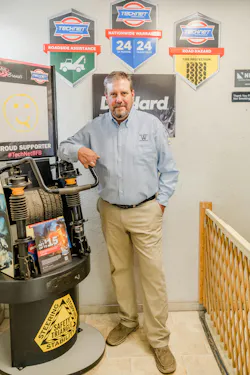
Vendor Relationships: Transparency vs. Pushback
How shops respond upstream often determines how much pain they and their customers ultimately feel.
For Shelton, the focus has been on communication and trust. His shop relies heavily on strong vendor relationships to avoid being blindsided by sudden increases.
“I’m looking for someone to have my back as a partner,” Shelton says. “If there’s going to be a price increase, I want a heads up. I don’t want to be shocked one day when something like Freon jumps hundreds of dollars.”
Helton takes a more aggressive stance but has the same goal in mind. With three locations and high purchasing volume, Arkatire has made it a priority to challenge price increases rather than simply accept them.
“We don’t just pass it on to the customer,” Helton says. “We challenge it with our vendors. We don’t accept blank price increases. We want to know why.”
Part of that process has meant stripping away what Helton calls “fluff”—rebates, incentive trips, SPIFF programs—and pushing for straightforward pricing instead.
“I want the best pricing I can get. I want to control my margin,” he says. “I don’t want them controlling it with some rebate program.”
Even for smaller shops, Helton says, competition among vendors is leverage owners shouldn’t ignore. “You may not have as much power,” he says, “But you still have options. Periodically challenging your pricing is just good business.”
Selling Value, not Just Price
While owners fight battles upstream, they’re also having more frequent and more delicate conversations at the counter.
“These days, people are always asking questions about price,” Shelton says. “They’ll say, ‘I’m seeing this online for cheaper. Why is yours higher?’”
Shelton’s response is rooted in long-term thinking.
“You can always get something cheaper,” he says. “But you get what you pay for. If it’s a buried part with a lot of labor, you don’t want to pay for that twice.”
Instead, Bailey’s leans into warranties and quality.
“You might pay a little more now,” Shelton says, “but you’ve got a three-year, 36,000-mile warranty. That peace of mind matters.”
Helton takes a similar approach, often offering tiered options while making sure customers understand the tradeoffs.
“We’re quoting the good stuff,” he says. “Interstate batteries, NAPA parts, Bridgestone tires. And if they want to step down a tier, we’ll explain that option. But with vehicles averaging over 13 years old now, people are realizing that going cheap can cost them more later.”
Deferred Work and Unintended Consequences
For Furrow, the biggest downstream impact of rising prices hasn’t just been sticker shock.
“I’ve seen about a 40% increase in declined work over the last three to five months,” he says. “Car count is up, but average repair order is down because people are waiting.”
Deferring maintenance, Furrow warns, rarely pays off.
“Prices aren’t going down,” he says. “I haven’t seen grocery prices go down yet. And parts prices won’t either.”
Some of the deferrals have been alarming.
“I’ve had customers decline batteries that are testing bad,” Furrow says. “Then they go out to the parking lot and need a jump. That’s mind-blowing.”
Preventive maintenance, he emphasizes, isn’t about upselling. It’s about protecting customers from bigger failures down the road.
“We’re trying to save the client money,” he says. “But they’re under pressure, too, and sometimes they just can’t see it.”
Don’t Race to the Bottom
Across all three shops, there’s a shared line owners are unwilling to cross: sacrificing quality or sustainability just to chase the lowest price.
“We’re the shock absorbers between distributors and customers,” Furrow says. “But if you try to absorb too much, your shop operations suffer.”
Furrow has long accepted being known as one of the more expensive shops in his market. It’s something he views as a strength.
“I’d rather be known as the more expensive, good shop,” he says. “Not the cheap shop that goes out of business.”
Helton agrees and says if you start looking at profit margin only, you’re going to make bad decisions.
“You’ll cut staffing. You’ll put cheap parts on,” he says. “And that’s a cycle of doom.”
Instead, he says, the formula hasn’t changed even as the pressures have intensified.
“Take care of your people. Take care of your customers,” he says. “That will take care of your profit. That’s never been more true than it is today.”
The Long View
Tariffs may be the latest pressure point, but they won’t be the last. The shops best positioned to weather what comes next are the ones focusing less on panic reactions and more on fundamentals—strong partnerships, honest communication, and a clear value proposition.
And in an era where almost everything costs more, that trust may be the most valuable asset a shop can have.
“Once customers understand what kind of shop you are,” Shelton says, “You’ve got a customer for life.”
About the Author
 Noah Brown
Noah Brown
Noah Brown is a freelance writer based in Stillwater, Minnesota. He graduated from the University of St. Thomas with a degree in journalism in 2019 an has covered the automotive aftermarket and vehicle technology sector since 2021.