Think Outside the Shop: How One Owner Turned Everyday Moments into Marketing Gold
Key Highlights
- Sasha Holley used unconventional marketing tactics like free branded merchandise and local collaborations to increase brand awareness.
- Partnerships with neighborhood businesses, such as tea shops and pizzerias, helped create memorable community interactions.
- The shop invested in merchandise and scratch-off promotions, turning customers into walking advertisements for the brand.
- Her approach emphasizes the importance of building genuine connections with the community outside traditional advertising methods.
- Sasha measures success through increased brand recognition and customer engagement, rather than solely relying on sales metrics.

In a town of 9,800 people, it’s easy to assume that everyone knows your shop’s name. But how can you be sure? And more importantly, how do you make sure you’re the first one they think of when they need auto repair? For Sasha Holley, co-owner of The Shop Georgia, the answer came down to one objective—thinking differently.
“My entire childhood, my dad told me you do not have to have a four-, six-, or eight-year degree. You do not have to be a brilliant, intelligent individual,” she recalls. “You only have to think outside the box to get ahead.”
Sasha really didn’t understand her dad’s message until five years after he passed away when she became the marketing guru for her business. Suddenly, everything clicked into place, and she found her calling in connecting with her community. And soon enough, she discovered the power of effective—albeit unusual—marketing.
“That’s my goal is how do I market to people when they aren’t needing me? How do I how have an interaction with people when your car doesn’t need to be repaired, but I want you to think about The Shop Georgia,” she notes.
Sasha’s efforts have left a sea of logos all over town and more importantly—a connection with her customers.

Backstory
Sasha and her husband, Trey, opened The Shop Georgia in 2018. Back then, the 3,200-square-foot business was simply called The Shop. They quickly realized that they would have to differentiate themselves if they wanted to find their footing.
“(People) would immediately say ‘what shop’ and you would have to explain that it’s the name, so we knew in the very early stages of the business being open that we had to stand out,” Sasha recalls.
Problem
Sasha knew she needed to build a brand—but not in the traditional sense. Trey didn’t want to invest in a marketer who didn’t understand their vision, so the responsibility fell to her. That’s when she returned to her father’s sage advice—think outside the box.
“I knew I had to find a way to connect and interact with people without them having to come to our business but have them say our name. Like you want to be the business that’s thought of when you need something,” she explains. “But that’s typically the only time somebody thinks of an automotive repair shop is when the check engine light’s on. So, I thought, ‘how do I get the community to talk about us?’”

Solution
Instead of focusing on radio stations, newspapers, billboards, and other traditional outlets to showcase the auto repair shop, Sasha partnered with other neighborhood businesses.
She created a signature tea at the local nutrition store called “The Shop Georgia” and every time someone ordered one, they got it for free. The shop reimbursed the owner for all of the tea sold in a single day. In all, she paid roughly $5,000 for 347 people to say “The Shop Georgia” in six hours.
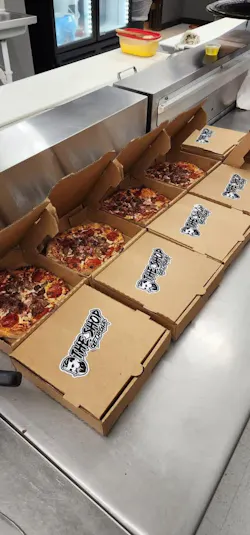
She teamed up with the local pizza parlor to give away 250 pizzas emblazoned with The Shop Georgia’s logo on the box. Five dollars per pizza netted $1,250 in advertising and a line that stretched around the block beginning at 7:45 a.m. when the pizza parlor didn’t even open until 11 a.m.
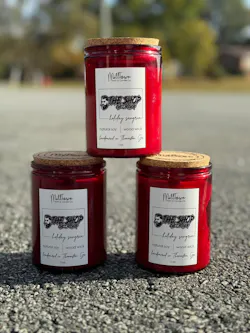
She gave away candles from a local artisan with The Shop Georgia’s logo on them to every customer who came in for service in November and December. At $10 per candle, she spent $1,000 to work her way into the homes of customers who shared with their friends.
“People come in their house and say, ‘It smells so good. What is that,” she notes. “So now it’s an experience. Now it’s an interaction outside of the shop.”
And then she turned to swag bags and merchandise. No customer leaves without a plastic stadium cup, a keychain, a pin, an air freshener, and their choice of a hat or a T-shirt—all sporting The Shop Georgia’s logo, of course.
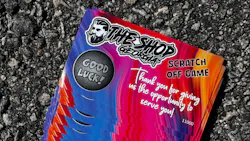
But her signature item was her scratch-offs. This past March, she leaned into the “lucky” theme and purchased 1,000 scratch-offs for a little over $500 that promised 750 winners $10, $20, $50, free oil changes, and free tickets to try again. Only 250 were losers.
Aftermath
With so many ways to interact with the brand, Sasha says it’s impossible not to see The Shop Georgia’s logo all over town.
“I can’t tell you the last time I left my house and didn’t see somebody with our merch on. It’s in restaurants, at Walmart, at the park, in the parts store. Like it’s everywhere,” she quips. So, I’m interacting with somebody without them needing anything from me because they’re putting our T-shirt on, our hat on, hopping in the car and going to buy groceries. So now they’re walking around advertising for me.”
Takeaway
Although some people might balk over the cost of goods, Sasha points out it’s pure investment in your brand. She encourages others to add up the cost of billboards, radio ads, newspaper articles, and paid ads on Facebook and then measure the return on your investment compared to her tactics.
“Everybody’s in the newspaper. You know, that’s just your typical traditional ways of marketing yourself or advertising,” Sasha notes. “But you’re not connecting with people necessarily because they’re going to look at your billboard and keep going if they don’t need automotive repair. But when you go in the tea store every morning because you’re hooked on the flavor, The Shop Georgia, I’ve built a connection with people outside of the automotive repair shop that’s long-lasting.”
How does she measure whether her efforts are working? She doesn’t have to.
“People ask me all the time, ‘What are you doing next? Can you tell me first?’”
That’s how she knows it’s working.
About the Author
 Christine Schaffran
 Christine Schaffran
Editor-in-Chief
Christine Schaffran is the Editor-in-Chief for Ratchet+Wrench magazine at Endeavor B2B. She is an award-winning journalist, having covered both commercial and industry magazines and newspapers during her career. She previously served as Editor-in-Chief for another publisher for 17 years prior to joining Endeavor. When she's not spending time with her husband and son, you'll find her in the kitchen experimenting with new recipes and delicious dishes to try.
Don't miss Christine Schaffran's next article. Sign up for Ratchet+Wrench's Insider and This Month in Ratchet+Wrench's newsletters.