How AI Is Changing How Auto Repair Shops Do Business
Key Highlights
- AI is helping auto shops reduce paperwork time and improve clarity in technician notes, especially for non-native English speakers.
- Experts advise testing and verifying AI tools before full implementation to ensure reliability and value addition.
- AI can support marketing, call sentiment analysis, and data analytics, providing shop owners with actionable insights and efficiency gains.
- Industry leaders warn against the hype, emphasizing that AI should complement human skills, not replace them, especially in customer interactions.
- The future of AI in auto repair involves strategic use, focusing on areas where it adds the most value while maintaining human oversight and empathy.

At Adam Liu’s three M-Spec Performance locations dotting Queens and Long Island, New York, artificial intelligence is slowly creeping into workflow, turning weaknesses into wins.
For example, the paperwork that taxes technicians and service advisors now takes a fraction of the time to write. Even better—the notes are complete and easy for customers to understand.
“I have some technicians that English is not their first language, and so for them to write up technical notes is quite difficult, but now it's not at all. Like their notes are amazing. Why? Because AI wrote them for them,” Liu points out.
While some are resistant to the technology for fear of unreliability or robots taking over the industry, AI can help solve pain points for those who embrace it. Although it won’t solve every problem—and it shouldn’t—used correctly, it can help to streamline and strengthen operations and leave more time for maintaining productivity and building customer relationships.

Liu admits not all AI is created equal, and it must be tested and verified before turning any process over to it, but he’s not afraid to try.
“AI is so helpful in so many ways that even the naysayers, unless they're so stubborn, will have to see the benefit,” he asserts.
Others in the industry tend to agree. According to the 2026 Ratchet+Wrench Industry Survey, 22% of respondents saw the greatest potential for AI in technician support while 20% favored marketing and customer communication (see sidebar, Where Do You See the Greatest Potential for AI to Help Your Business?).
To further embrace its capabilities, Liu has moved beyond paperwork and into marketing, call sentiment, analytics, and AI agents.
It’s been a progression with bumps and learning curves, but the experimentation has a significant payoff for Liu’s employees and their workflow.
“You don't have to do everything with AI if you don't want to, but you can't be afraid of it,” he notes. “You have to learn about it. You have to understand how it works. You have to understand how to manipulate it. You have to understand how to work around it.
For shop owners who are still weighing how—and where—to use AI, the technology is already changing everything from the way customers search for repairs to how employees handle everyday tasks. And the potential applications are only expanding.

Beyond the Hype
As an industry resource that provides digital marketing solutions to auto repair shops, Autoshop Solutions is no stranger to changing technology. In fact, it’s typically at the forefront of these headwinds that help to shape the most beneficial resources for shop owners. When it comes to AI, however, Vice President of Revenue Tony Mercury cautions against getting caught up in a craze that may only be sustainable for the short term.
“There's all these new pop-ups every single day (promising to) do this and do that, but they don't have a large user base,” he cautions. “They don't have time in the industry. They're kind of just these new pop-up overnight operations.
Instead, Mercury notes, shop owners should be paying particular attention to how AI is changing consumer behavior. He notes that while conversations with ChatGPT and Claude are helping customers self-diagnose their problems and appear to be knowledgeable, they’re merely repeating information they were given during the AI discussion.
“So, you have your equation, but you don't have the equal sign and what the actual solution is behind it,” he notes. “Like you still have to talk to a human.”
He points out that this is where shop owners can take the reins and help customers connect the dots to make sound decisions using their own knowledge base and expertise instead of relying on possibilities thrown out by a chatbot.
Where Technology Shines
Mercury also encourages shop owners to lean into technology—not to replace people—but to become a “force multiplier” to make people more efficient at their jobs. He uses an example that he refers to as “swivel chair reporting” to drive home the point.
“You're going to system A, you're pulling a couple data points, you're going to system B, you're going to system C,” he explains. “So let the agent do that and build that dashboard for you. And then you can have it sync, you can have it refreshable, where you can just go in every morning at 7 a.m. all your data points are ready, and it can recap the previous day.”
In this way, he says, shop owners can leverage AI not to make decisions on their behalf, but to provide the information needed to make those decisions easier to see.
Similarly, Mercury says, is how service advisors can use chatbots to pool information to have more informed discussions with customers. In addition to personal information, the agent can feed data points to pick up where you left off in a previous conversation.
“So, you can say, ‘hey, are you calling back in … about the brakes we recommended last time you were here,’ or, ‘I see you’re approaching your 40,000-mile. Have you considered doing that service yet,’” he explains. “So, it’s just feeding and guiding that conversation. That’s going to be a huge help.”
When it comes to estimates, Liu says, AI can be helpful, particularly for those who do not have a strong service background.
“The industry certainly has gone in the way of hiring … people from (other industries) like hospitality that don't necessarily know about cars,” he points out. “And this is just another thing that's going to help them make that transition much easier in case they have to estimate their own tickets. And … it creates a lot more efficiency in the shop.”
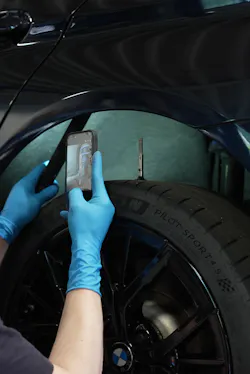
Liu envisions AI may also have a role in delivering digital video inspections that involve technicians using a pair of glasses while walking around a vehicle or examining its underside to point out current or potential maintenance priorities.
“And it takes that video data and then creates pictures, videos, and explanations on a DVI automatically so that a technician doesn't have to write anything or even post anything,” he explains. “That's probably not ready today … but it's going to happen eventually.”
Humans are Still Desired
And while technology continues to improve and shop owners continue to find ways to use it for efficiency, there are some areas where it falls short—particularly in the customer experience.
For example, Mercury says, while AI is beneficial outside regular business hours, he cautions against trying to use it during the day or for overflow, as many still want to connect with a human who can decipher connections and emotion.
“They're never going to be as dynamic as a human, especially understanding tone and inflection. Some people, their car is their life, it's a part of their family,” he explains. “So, it's really discerning, ‘Do they just want to get the car in or do they want a whole conversation’?”
Although AI is currently unable to make these distinctions, Mercury notes, “it’s very quickly getting there.”
Mercury surmises that although AI and similar technologies are experiencing a heyday, the bubble will eventually burst, similar to the dot-com boom of the 2000s, and only a few major players will be left standing.
“Once we hit this critical mass of AI adoption, I think it's going to come back down. It won't go back down to zero, but maybe one-third or two-thirds blend of AI to human,” he asserts. “And I really think in the future, we're going to see big advertising campaigns that like we're a human-first organization. Because I think a lot of people are going to be looking for human interaction.”
For shop owners, the takeaway isn’t to find a way to incorporate AI into every process. It’s to understand where the technology can make the business better, use it where it adds value, and know when a human should remain in the driver’s seat. As AI continues to evolve, the shops that benefit most may not be those using it everywhere, but those using it wisely.
Where AI Can Help
AI can take on a range of tasks throughout the shop, from routine paperwork to organizing information. Here are some of the applications highlighted by Liu and Mercury:
- Technician notes. Turns shorthand or rough notes into clear, customer-friendly documentation.
- Call analysis. Identifies service inquiries, leads, sentiment, and conversion trends.
- Reporting. Pulls information from multiple systems and compiles it into a dashboard or daily recap.
- Customer follow-up. Uncovers previous recommendations, maintenance intervals, and customer history to help advisors guide conversations.
- Estimating. Gives less-experienced service advisors additional support when building estimates.
- Digital vehicle inspections. Eventually, AI could help capture and organize photos, videos, and explanations automatically.
Where Do You See the Greatest Potential for AI to Help Your Business?
|
Technician support |
22% |
|
Marketing and customer communications |
20% |
|
None |
14% |
|
Scheduling and workflow |
11% |
|
Vehicle scanning/estimating |
11% |
|
Business analytics |
10% |
|
Parts identification |
7% |
|
Training and onboarding |
5% |
The New Search
As customers increasingly turn to AI for answers, repair shops may have a new opportunity to get in front of potential customers.
Consumers have long turned to Google to find information about their vehicles and local repair shops. Now, generative AI is giving them another way to search—one that looks less like a list of links and more like a conversation. Joe Toscano, CEO and founder of Service Stories, explains what the shift could mean for repair shops and how they can start thinking about their existing repair information as a digital marketing asset.
Q: For years, repair shops have focused on showing up in Google searches such as "auto repair near me." How is generative AI changing the way customers find businesses?
Toscano: What’s changing is the user input. Instead of typing two or three keywords, people are now chatting with their phone as if they’re voice texting a friend. Customers are getting answers from generative AI, either through Google or AI chat. Shops that directly answer specific questions using real facts and work experience are more likely to get mentioned by AI.
The question owners need to ask themselves is: How do they create content to answer the near-infinite variety of questions people ask the internet? This creates a significant opportunity for shops to reach customers through AI search.
Q: What happens when a customer asks an AI tool a specific question about a vehicle problem rather than searching for a repair shop directly? What does that mean for the shops that get recommended in those answers?
T: When a customer asks something specific, like “Why is my Toyota Camry AC blowing hot air?” AI tools will likely provide an explanation immediately. Whether the answer is right or not, customers are increasingly relying on these answers. If AI suggests a business, that puts the shop directly in front of a customer who is already looking for help.
Q: You've said shops already have a wealth of information that could help them become more visible in this environment. What information are shops sitting on, and how can they make better use of it?
Every day, customers visit shops and bring with them the same questions they may have asked the internet. If the front desk is doing its job well, they’ll have notes about what the customer’s concerns were. The next step is that the shop will inspect the vehicle (likely through DVI) and turn that into a repair order the customer can approve. Together, those records contain what shops need to create content that answers real customer concerns. And if one person asked, there are likely many others asking the internet the same thing.
Q: Does optimizing for AI-driven discovery replace traditional SEO and Google marketing, or should shops think about this as an additional piece of their digital strategy?
T: At this point, consider AI search as a secondary channel that’s quickly becoming the primary channel, potentially within two to three years.
Today the top Google search spot is similar to real estate in a city center: well-established, competitive, and expensive. An AI search is more like the suburbs: less competitive, and easier to establish a presence today than it will be 5 or 10 years down the road when everything is developed and expensive.
The good news is that, done well, content created for AI search can strengthen existing SEO work rather than compete with it. It can help shops build a stronger overall web presence.
Q: For a shop owner who wants to start preparing for this shift, what are one or two things they can do now?
T: First, if you haven’t already, play around with AI search. Try Google or ChatGPT, and ask the same question several times. Get an understanding of how inconsistent the answers can be and how incredibly intelligent they can be.
Next, pull a couple of repair orders to see how well your team is documenting your work. Take one customer concern and run a Google search to see what you can find. Then ask an AI tool the same question and see what information it provides.
If you find that your shop has information or experience that could answer the question, turn that real-world knowledge into useful content on your website. It could be a short article, FAQ, or service page based on the repairs your shop is already performing. Try it once a week for three months, and see what happens. The goal is to turn the work you’re already doing into useful content without adding significant time to your team’s workload.
About the Author
 Christine Schaffran
Editor-in-Chief
Christine Schaffran is the Editor-in-Chief for Ratchet+Wrench magazine at Endeavor B2B. She is an award-winning journalist, having covered both commercial and industry magazines and newspapers during her career. She previously served as Editor-in-Chief for another publisher for 17 years prior to joining Endeavor. When she's not spending time with her husband and son, you'll find her in the kitchen experimenting with new recipes and delicious dishes to try.
Don't miss Christine Schaffran's next article. Sign up for Ratchet+Wrench's Insider and This Month in Ratchet+Wrench's newsletters.